It was not like I had a lot of respect for cricket commentators to begin with. Except when something very special happens in the game, what they say in a particular situation can easily be predicted. Lets say the batsman comes out of the crease for the very first ball he faces and hits the ball over the head of long-on fielder for a six. The commentator will say something like "He has decided to take the bull by it's horns, take the fight to the opposition. It is his natural style and it is a good idea to play your natural game while chasing such a total" Lets say the batsman was not that lucky and ends up sending the ball 'down the throat' of the fielder at long on. The same commentator would now say something like "This shot was absolutely not needed at this time of the game. The need of the hour was to consolidate and go for shots only towards the end of the game".
Recently I played Cricket 2007 game on Windows. This is a pretty nice game, but I admit I am not a game junkie, so it is easy to impress me. The game has pretty good animation, realism and gameplay. But what is commentary without the commentary? So the game contains pretty interesting commentary. They must have analyzed what typical commentators say in various situations in the game and made some voice snippets for each. Lets say it is a six. The commentary is one among "That is huge, he hit it right out of the ground" or "It doesn't matter when he hits it in the air when he hits it so far" or "Oh, I don't think it was a bad ball either" or "The bowler can't really complain, because it was not such a great ball. I am sure the captain won't be very happy with that" and so on. They play one of these randomly depending on the situation. Sometimes they play 2 or 3 together. However, what surprised me is that the commentary doesn't sound too repetitive/boring/unnatural compared to the real one! It sounds pretty alright.
This confirms my suspicion that commentary is not such a great skill after all. If you just collect a bunch of things to say in every situation and play them randomly, that is good enough! Even games can do a pretty good job of it. When I watch cricket matches, I don't mute the TV, because I like to hear the noise created by spectators in the ground. I am not that particular about the commentary.
Saturday, March 29, 2008

Monday, March 24, 2008
How valuable is a life?
Today, Bangalore's newspapers had reported the news about a 'techie' killing his wife and committing suicide as the prime news on the first page. I could not understand why all newspapers thought this was the most important news of the day. FM radio stations, not to be left behind, were asking the listeners to send their opinion about the incidence through an SMS to them.
Don't get me wrong. I definitely feel sorry for the young couple and wish their lives had not ended tragically this way. However, this is not the first time entire families have ended their lives in such a tragic way in this city. If you sift through the newspapers, you could find at least one incidence in a month where a mother poisons her children and ends her life, a farmer, not being able to bare the burden of loans, kills himself and so on. Such news gets reported somewhere deep in the internal sheets, hard to find even if you are looking for. However, this incidence gained so much of importance only because the person involved is a 'techie'. (a unique word coined by Indian media which could mean anything from a people manager in a software company to a call center executive in a BPO company.) My thoughts when I saw this were, is the life of a techie more valuable than that of, say, a Government employee? If not, do the newspapers do this only because the readers are more interested in reading about the life of a techie than that of a more humble person? Or is it because.... I don't know...
After all, the families of the deceased would hate nothing more than media glare on the private lives of their
dear ones after this tragedy. I hope the media leaves them alone.
Don't get me wrong. I definitely feel sorry for the young couple and wish their lives had not ended tragically this way. However, this is not the first time entire families have ended their lives in such a tragic way in this city. If you sift through the newspapers, you could find at least one incidence in a month where a mother poisons her children and ends her life, a farmer, not being able to bare the burden of loans, kills himself and so on. Such news gets reported somewhere deep in the internal sheets, hard to find even if you are looking for. However, this incidence gained so much of importance only because the person involved is a 'techie'. (a unique word coined by Indian media which could mean anything from a people manager in a software company to a call center executive in a BPO company.) My thoughts when I saw this were, is the life of a techie more valuable than that of, say, a Government employee? If not, do the newspapers do this only because the readers are more interested in reading about the life of a techie than that of a more humble person? Or is it because.... I don't know...
After all, the families of the deceased would hate nothing more than media glare on the private lives of their
dear ones after this tragedy. I hope the media leaves them alone.
Sunday, January 27, 2008
White collar 'crimes'
When I have a quick water cooler chat at work or when I meet people over lunch, one of the favorite topics of discussion is traffic problem. I often hear my friends/colleagues complain about a truck/auto/cab driver driving recklessly and causing danger to everyone on the road. Sometimes the discussion moves on to other related areas of public nuisance. I hear people complaining about the behavior of parking lot attenders at work, cafeteria crew, traffic cops, apartment construction companies, the Government, etc.
If a total outsider, like a foreigner were to join such a discussion, he/she would get this picture: The lower strata of the society, where there are less educated, poor/lower middle class people, is what causes *all* of the problems in Indian society. Bangalore is a better place because it has a large number of software engineers, who are a much better breed. Because hey, you don't hear complaints about other software engineers or other such white collar people. If we were to only look at the English language media, the same opinion will be cemented in our mind.
So in my opinion, software engineers, being the most educated, creamy layer of the society, should be setting examples for others to follow. But are we really doing it? Do we always behave on the road, following all road rules? Do we all stick to lane discipline while taking U-turns? Do we treat the parking lot attenders with respect? Do we thank them for their help in parking our vehicle? Do we thank any support staff at our office? If we ever did, do we do it with a smile on our face?
Whenever I see a silly traffic jam being created by a well heeled, sophisticated type of person in a Corolla, I get doubly angry than seeing a call center cab do the same mistake. Other examples are my colleagues spilling coffee in the microwave and not bother to clean it up, jump queues at the cafeteria, spit chewing gum in the rest room wash basin and so on.
If a total outsider, like a foreigner were to join such a discussion, he/she would get this picture: The lower strata of the society, where there are less educated, poor/lower middle class people, is what causes *all* of the problems in Indian society. Bangalore is a better place because it has a large number of software engineers, who are a much better breed. Because hey, you don't hear complaints about other software engineers or other such white collar people. If we were to only look at the English language media, the same opinion will be cemented in our mind.
So in my opinion, software engineers, being the most educated, creamy layer of the society, should be setting examples for others to follow. But are we really doing it? Do we always behave on the road, following all road rules? Do we all stick to lane discipline while taking U-turns? Do we treat the parking lot attenders with respect? Do we thank them for their help in parking our vehicle? Do we thank any support staff at our office? If we ever did, do we do it with a smile on our face?
Whenever I see a silly traffic jam being created by a well heeled, sophisticated type of person in a Corolla, I get doubly angry than seeing a call center cab do the same mistake. Other examples are my colleagues spilling coffee in the microwave and not bother to clean it up, jump queues at the cafeteria, spit chewing gum in the rest room wash basin and so on.
Thursday, January 17, 2008
The way things change and the way they don't
I visit my native place (a small village right at the sea coast in Udupi district) once or twice a year, for a couple of days. My visits were much more frequent when I was a kid. Hence most of my memories of my native place are from my childhood. This often makes me blind to the changes that have happened there and I continue to think that the place is as it was a couple of decades back. However, when I see carefully, the changes are vast. Modernisation has swept the entire district and changed it forever.
I clearly remember walking 2 kms from the nearby town Saligrama to reach my grandfather's house, because we would have to wait 4 hours for the next bus. Now, people in the village don't depend on buses which ply every 30minutes. All auto drivers in the town have cell phones. People in the village just call them up and within 15 minutes, you have the auto at your door. People don't mind shelling out 50Rs for this. Also, walking those 2 kms to the town is close to non-existent now.
There are innumerable things that have changed rapidly in the last decade or so. People are eating chaats, buying expensive cars, sending their children to English medium schools, are already tired of Big Bazaar, just like their counterparts in Bangalore. Seeing all this, it is often easy to conclude that everything has changed.
The last time I was in my native place, it was for the annual religious ceremony at the village temple. I had not attended this event for a very long time. I have fond memories of this ceremony from my childhood, when the entire day would be filled with fun and frolic for us. It ended with a grand puja in the evening, followed by distribution of 'prasada' that was extremely tasty. This time, I was observing to see how this has changed in the last couple of decades.
First and foremost, I observed that I was the _only_ one in the entire gathering of hundreds of people who was wearing a trouser, everyone else was in a dhoti. There is no restriction that one should not wear trousers at this event, so I was very surprised to see that even teenagers had worn a dhoti. Later, I observed that the process of the puja had remained virtually unchanged since my childhood. The same procedure, the same puja, kids having a fun time running around the place, elders trying to bring them to order, nostalgic senior citizens... Everything was just the same. For a few hours, I was transported back in time by 20 years.
It is my gut feeling that things will change here too. Eventually, young people will attend the puja wearing cargos or even shorts and eventually there will also be jeans-wearing girls. But for now, the place has resisted the sweeping change and has clung on to an era gone by. I wonder for how much longer.
I clearly remember walking 2 kms from the nearby town Saligrama to reach my grandfather's house, because we would have to wait 4 hours for the next bus. Now, people in the village don't depend on buses which ply every 30minutes. All auto drivers in the town have cell phones. People in the village just call them up and within 15 minutes, you have the auto at your door. People don't mind shelling out 50Rs for this. Also, walking those 2 kms to the town is close to non-existent now.
There are innumerable things that have changed rapidly in the last decade or so. People are eating chaats, buying expensive cars, sending their children to English medium schools, are already tired of Big Bazaar, just like their counterparts in Bangalore. Seeing all this, it is often easy to conclude that everything has changed.
The last time I was in my native place, it was for the annual religious ceremony at the village temple. I had not attended this event for a very long time. I have fond memories of this ceremony from my childhood, when the entire day would be filled with fun and frolic for us. It ended with a grand puja in the evening, followed by distribution of 'prasada' that was extremely tasty. This time, I was observing to see how this has changed in the last couple of decades.
First and foremost, I observed that I was the _only_ one in the entire gathering of hundreds of people who was wearing a trouser, everyone else was in a dhoti. There is no restriction that one should not wear trousers at this event, so I was very surprised to see that even teenagers had worn a dhoti. Later, I observed that the process of the puja had remained virtually unchanged since my childhood. The same procedure, the same puja, kids having a fun time running around the place, elders trying to bring them to order, nostalgic senior citizens... Everything was just the same. For a few hours, I was transported back in time by 20 years.
It is my gut feeling that things will change here too. Eventually, young people will attend the puja wearing cargos or even shorts and eventually there will also be jeans-wearing girls. But for now, the place has resisted the sweeping change and has clung on to an era gone by. I wonder for how much longer.
Sunday, January 13, 2008
What's in a name?
When I became a father 3 months back, I had no idea how difficult it was going to be to find a name for my daughter. After all, I have succeeded in giving wonderful (I think so) names to other's kids in the past. How difficult could it be to name my own kid? From what I have learnt in the last few months, a lot. I and my wife had a clear idea of the kind of name we wanted for our baby. However, her idea was completely different from mine :-)
These days, there are a number of avenues available to search for names. There are the good old books, there is the Internet and of course, there are relatives. Relatives suggested names from various places. Some worked as teachers and they remembered the names of all the kids in their class, some suggested names from TV serials, some suggested names they had heard, names of kids of their friends and so on. We read through a couple of "Baby names" books and went through a number of websites.
One of the main problems in reaching a conclusion is that we want a name that has a nice meaning, or at least not have a bad meaning. These days it is easy to choose a cute, sweet name for your baby, having heard it somewhere among your relatives and later realize that the name actually means "lunatic". Most baby name websites publish meanings of the names. However, the meanings are either whatever was given by contributors to the website, or given by whoever among their employees was free when the name was added to the site. It is not uncommon to see a name that doesn't mean anything, but someone in some website says it has some meaning in Hebrew. Or Icelandic.
It was very difficult to find names that was acceptable to both me and my wife and also had a nice meaning. We have not even bothered to get a consensus from other stakeholders. After a lot of effort, we have narrowed down to a small list of names. Next weekend is the deadline before which we need to narrow it down to just one name. Wish me luck please. And never underestimate the complexity of the process of naming your baby.
These days, there are a number of avenues available to search for names. There are the good old books, there is the Internet and of course, there are relatives. Relatives suggested names from various places. Some worked as teachers and they remembered the names of all the kids in their class, some suggested names from TV serials, some suggested names they had heard, names of kids of their friends and so on. We read through a couple of "Baby names" books and went through a number of websites.
One of the main problems in reaching a conclusion is that we want a name that has a nice meaning, or at least not have a bad meaning. These days it is easy to choose a cute, sweet name for your baby, having heard it somewhere among your relatives and later realize that the name actually means "lunatic". Most baby name websites publish meanings of the names. However, the meanings are either whatever was given by contributors to the website, or given by whoever among their employees was free when the name was added to the site. It is not uncommon to see a name that doesn't mean anything, but someone in some website says it has some meaning in Hebrew. Or Icelandic.
It was very difficult to find names that was acceptable to both me and my wife and also had a nice meaning. We have not even bothered to get a consensus from other stakeholders. After a lot of effort, we have narrowed down to a small list of names. Next weekend is the deadline before which we need to narrow it down to just one name. Wish me luck please. And never underestimate the complexity of the process of naming your baby.
Thursday, December 27, 2007
Beach trek!
Probably the biggest adventurous thing I do on a day-to-day basis is driving through the BTM ring road between 9 and 10AM. However, every now and then, a deep voice within me instigates me to to something really adventurous. I usually ignore it as an indication of indigestion. However, once in a while I lose my sense and decide to indulge in something like going on a trek. December 15-16 weekend was one such time. It was going to be a 'beach trek', which meant, instead of climbing mountains, we were going to walk tens of kilometers along a beach. Not that it is any less insane.
We were a bunch of software engineers at different levels of physical fitness. There were some who had done a Himalayan expedition in the last couple of years, whereas there were some whose most physically strenuous job in the last few months involved a walk from a distant outdoor car parking lot (gasp!). My own glorious trekking past had ended a number of years back. Hence it was like putting Schumacher and a M-800 driver in the same car racing team.

We set out to Bhatkal in a bus, from where our trek was supposed to begin. It is a town approximately 500Kms from Bangalore, along the western coast of Karnataka. Our journey in a KSRTC bus lasted just about 14.5 hours at an impressive rate of 35Km per hour. By the time we reached, it was 9:30 in the morning on a hot and sunny day. By the time we were at the beach, it was what experts call the right time to walk on a sunny, hot beach for hours: 12 in the noon. Our plan was to walk till Byndoor on the first day and on the second day, walk till Maravanthe, which is probably one of the most beautiful beaches anywhere in India.
It took approximately 30 minutes for our initial euphoria to dry up and realize that the day was going to be harsh, hot and sticky. We quickly learnt a valuable lesson that walking a long distance on a surface that inclines from left to right can be bad for your left ankle. There were hardly any people on the beach, leading us to wonder if the population density of coastal Karnataka had come down drastically in the recent times. (I thought Tsunami hit the east coast of India, not the west!) We stopped at a coconut grove for our lunch, the best planned activity of our trek. After a while, we stopped for a dip at a fresh water lake right next to the beach. The vast sea seems like a powerful salt water empire, against which the little fresh water lakes seem to be trying to hold on to their own identity. Some more rigorous walk ensued and we eventually reached Byndoor. Success for day 1.


(Pic1: Sripathi, Chandra, Hariharan, Bharadwaj, Prasanna, Naren and Bharata. Pic2: Same folks + Chandru)
On day 2, after carefully considering all the factors, like the heat factor, the sweat factor, the strain factor and the i_prefer_AC_rooms_to_beach factor, some of us, specifically the M800 types, contemplated skipping the beach and catching a bus to Kundapura. After all, the road runs close to the beach, so we could still enjoy the beach from up close, without actually interacting with it's 'factors'. However, Bharata, our team lead for the trek, dangled the carrot of doing most of the walking early in the morning, before it got too hot. So we set out on day 2 and by 8AM, we were at the beach. The weather was quite pleasant and the beach was much flatter than the previous day, giving our ankles much needed support. Within the first hour, we had walked almost 5 kilometers. By noon, we had pretty much walked the entire distance.
 We saw a lot more people on the beach early in the morning. It confirmed our suspicion that the area was in fact pretty well populated, but the native people had much too common sense to be walking on hot sand in the noon. Tens of children were playing on the beach and _all_ of them wanted us to take their photos. It left me wondering "These kids are not going to see these pictures _ever_ in their life again, why do they still want to get their picture taken?"
We had to cross 2 river mouths in these two days. We took help from local fishermen for this. What surprised us was that on both the occasions, the boatman refused to take any money from us for his efforts. Especially on day 2, a boatman invited us to use his boat, did 2 trips across the river, but flatly refused any money. All I can say is these people have not gotten in touch with the auto-rickshaw drivers of Bangalore.
By around 1PM, we had entered Maravanthe. Bharata proposed that, since we had met the objectives of the project, we call the trek over and and travel onward to Kundapura in a bus. Not surprisingly, the proposal was approved with 100% votes by the team. We checked into a lodge in Kundapur for the rest of the day and took the night bus to Bangalore.
PS: The 'official' travelogue should appear on Bharata's blog soon.
We were a bunch of software engineers at different levels of physical fitness. There were some who had done a Himalayan expedition in the last couple of years, whereas there were some whose most physically strenuous job in the last few months involved a walk from a distant outdoor car parking lot (gasp!). My own glorious trekking past had ended a number of years back. Hence it was like putting Schumacher and a M-800 driver in the same car racing team.

We set out to Bhatkal in a bus, from where our trek was supposed to begin. It is a town approximately 500Kms from Bangalore, along the western coast of Karnataka. Our journey in a KSRTC bus lasted just about 14.5 hours at an impressive rate of 35Km per hour. By the time we reached, it was 9:30 in the morning on a hot and sunny day. By the time we were at the beach, it was what experts call the right time to walk on a sunny, hot beach for hours: 12 in the noon. Our plan was to walk till Byndoor on the first day and on the second day, walk till Maravanthe, which is probably one of the most beautiful beaches anywhere in India.
It took approximately 30 minutes for our initial euphoria to dry up and realize that the day was going to be harsh, hot and sticky. We quickly learnt a valuable lesson that walking a long distance on a surface that inclines from left to right can be bad for your left ankle. There were hardly any people on the beach, leading us to wonder if the population density of coastal Karnataka had come down drastically in the recent times. (I thought Tsunami hit the east coast of India, not the west!) We stopped at a coconut grove for our lunch, the best planned activity of our trek. After a while, we stopped for a dip at a fresh water lake right next to the beach. The vast sea seems like a powerful salt water empire, against which the little fresh water lakes seem to be trying to hold on to their own identity. Some more rigorous walk ensued and we eventually reached Byndoor. Success for day 1.


(Pic1: Sripathi, Chandra, Hariharan, Bharadwaj, Prasanna, Naren and Bharata. Pic2: Same folks + Chandru)
On day 2, after carefully considering all the factors, like the heat factor, the sweat factor, the strain factor and the i_prefer_AC_rooms_to_beach factor, some of us, specifically the M800 types, contemplated skipping the beach and catching a bus to Kundapura. After all, the road runs close to the beach, so we could still enjoy the beach from up close, without actually interacting with it's 'factors'. However, Bharata, our team lead for the trek, dangled the carrot of doing most of the walking early in the morning, before it got too hot. So we set out on day 2 and by 8AM, we were at the beach. The weather was quite pleasant and the beach was much flatter than the previous day, giving our ankles much needed support. Within the first hour, we had walked almost 5 kilometers. By noon, we had pretty much walked the entire distance.
 We saw a lot more people on the beach early in the morning. It confirmed our suspicion that the area was in fact pretty well populated, but the native people had much too common sense to be walking on hot sand in the noon. Tens of children were playing on the beach and _all_ of them wanted us to take their photos. It left me wondering "These kids are not going to see these pictures _ever_ in their life again, why do they still want to get their picture taken?"
We had to cross 2 river mouths in these two days. We took help from local fishermen for this. What surprised us was that on both the occasions, the boatman refused to take any money from us for his efforts. Especially on day 2, a boatman invited us to use his boat, did 2 trips across the river, but flatly refused any money. All I can say is these people have not gotten in touch with the auto-rickshaw drivers of Bangalore.
By around 1PM, we had entered Maravanthe. Bharata proposed that, since we had met the objectives of the project, we call the trek over and and travel onward to Kundapura in a bus. Not surprisingly, the proposal was approved with 100% votes by the team. We checked into a lodge in Kundapur for the rest of the day and took the night bus to Bangalore.
PS: The 'official' travelogue should appear on Bharata's blog soon.
Saturday, November 10, 2007
Ironies of life
Recently I became a father of a baby girl. We were in a hospital in Jayanagar and there were scrores of my relatives and friends visiting us, to see the baby and wish us. We had kept some sweets ready in our hospital room to offer to the visitors. What I observed was that most of the visitors were reluctant to pick up a full piece of sweet, either because they were diabetic or because they were trying to lose weight. Most just ate a small piece, that too after mentioning that they should not really be eating it.
Later, I went around the hospital floor to offer sweets to the staff there. Their approach towards the sweet was in stark contrast to our visitors. While nurses picked up a full piece of sweet without any qualm, some of the the cleaning staff (ayahs) actually asked me if they could take a second piece as well. I saw one of them preserving the second piece which she said was for her son.
This had a profound impact on me. While we go around offerring something to people who already have too much of it or don't want to have it, there are others who want to have it, but probably won't even be offerred. I then took out a box of sweets and left it at a desk where the hospital staff can take from at will. At the end of the our stay in the hospital, the box I left at the desk was empty, whereas the one I had kept in my room was not :-)
Later, I went around the hospital floor to offer sweets to the staff there. Their approach towards the sweet was in stark contrast to our visitors. While nurses picked up a full piece of sweet without any qualm, some of the the cleaning staff (ayahs) actually asked me if they could take a second piece as well. I saw one of them preserving the second piece which she said was for her son.
This had a profound impact on me. While we go around offerring something to people who already have too much of it or don't want to have it, there are others who want to have it, but probably won't even be offerred. I then took out a box of sweets and left it at a desk where the hospital staff can take from at will. At the end of the our stay in the hospital, the box I left at the desk was empty, whereas the one I had kept in my room was not :-)
Tuesday, October 02, 2007
Controversy about honoring sports persons
When India won the T-20 world championship, everybody, including the state Government, PSUs, BCCI, media and private companies showered the winning team with praises, money and endorsements. This was widely publicized in the media and the Governments which did not reward crickets from their state (TN, Gujarat) were hounded and criticized until they too succumbed and announced cash awards. This resulted in other sports persons raising serious objection about the step-motherly treatment they are dished out. Hockey players had recently won the Asia cup, others had won world championships in snooker and billiards. The media and eminent persons of the society joined the uproar. Hockey players wondered why Sahara group, which sponsors the cricket team as well as the hockey team, treats these two differently when it comes to shelling out money. Quickly, the state Governments were in defense mode. Some of them hurriedly announced cash awards to these sports persons too. The controversy is not dying down fully yet. Vishwanathan Anand, after winning the world chess championship, has wondered what kind of reception he is going to get from the people back home, considering that they showered their love on the winning Indian cricket team.
As I think about this episode, some things are clear in my mind. First of all, it was wrong on the part of the Governments to go over the top in honoring the cricketers while neglecting other sports persons. In fact, the Governments could have done away with giving any cash to the cricketers, because they are getting a good amount of money from Sahara, BCCI and endorsement deals. They could have instead spent the money on other sports and that would have been a genuine encouragement to these sports. Finally, rewarding sports persons does not make our politicians any great. After all, it is the public money they are spending, not money from their own pockets.
Secondly, corporate sponsors like Sahara. They are a company engaged in making profits. They should and do think of their profits all the time, hence they are going to spend money only in places where they believe they have a good return on investment. It is not that they have a special interest in cricket. If hockey (or, say, Kabaddi) was the most popular game in India, they would have spent the money on hockey, not cricket. Hence, why blame them? We don't care to even watch a hockey game on TV, so how can we expect corporates to shower money on the game? There is no use forcing anyone - Governments, corporates, media to give more importance to other games. If we watch these games, these things will happen automatically.
Third, some games are inherently not as enjoyable for the general public as others. For example, there is no way whole India is going to sit at the edge of their chair and watch Vishwanathan battle it out for the chess world championship. So Vishy, please don't expect a massive gathering of people along your victory parade from Chennai airport to the city in an open bus.
As I think about this episode, some things are clear in my mind. First of all, it was wrong on the part of the Governments to go over the top in honoring the cricketers while neglecting other sports persons. In fact, the Governments could have done away with giving any cash to the cricketers, because they are getting a good amount of money from Sahara, BCCI and endorsement deals. They could have instead spent the money on other sports and that would have been a genuine encouragement to these sports. Finally, rewarding sports persons does not make our politicians any great. After all, it is the public money they are spending, not money from their own pockets.
Secondly, corporate sponsors like Sahara. They are a company engaged in making profits. They should and do think of their profits all the time, hence they are going to spend money only in places where they believe they have a good return on investment. It is not that they have a special interest in cricket. If hockey (or, say, Kabaddi) was the most popular game in India, they would have spent the money on hockey, not cricket. Hence, why blame them? We don't care to even watch a hockey game on TV, so how can we expect corporates to shower money on the game? There is no use forcing anyone - Governments, corporates, media to give more importance to other games. If we watch these games, these things will happen automatically.
Third, some games are inherently not as enjoyable for the general public as others. For example, there is no way whole India is going to sit at the edge of their chair and watch Vishwanathan battle it out for the chess world championship. So Vishy, please don't expect a massive gathering of people along your victory parade from Chennai airport to the city in an open bus.
Monday, September 24, 2007
Why thank (just) Muslims around the world?
At the presentation ceremony of today's Twenty-20 finals, Shoib Malik said: "First of all I'd like to thank people back home and the Muslims around the world." I really don't understand why he has to thank people of a religion particularly. Does he think people of other religions never support Pakistan? Why is that so? BTW, India is home to nearly as many Muslims as Pakistan itself!
South Indian = Madrasi
North Indians have always been poor at differentiating between the people from the four southern states and appreciating the difference between their languages, cultures and ways of life. Any south Indian is referred to as a "Madrasi". With the vast movement of North Indians to cities like Bangalore, Hyderabad and Chennai in recent times, I was expecting that the situation would have changed by now. I was expecting that at least TV channels would be able to make this distinction very well.
A few days back I was watching a discussion on CNN-IBN. English news channels live on hype and they had a mouth-watering topic that day - the controversy related to the Sethusamudram project. One of the participants was a historian from Tamilnadu, I don't remember his name now. The discussion was moving on the lines of "Is Lord Sri Ram only popular in the North India? Is he relevant in the south?". The anchor asked the historian if he could elaborate. The historian said something on the lines of "Ram is not worshipped in Tamilnadu. There are hardly any temples for Ram in Tamilnadu. In fact many believe that worshipping Ram brings ill fate" At this stage, the anchor concluded something like this: "So worshipping Ram is limited to North India. Since South Indians don't worship Ram, we can't say that Ram is an integral part of Hindus in India." These are not the exact words she used, but pretty close.
Now, I really don't know whether Lord Ram is worshipped much in TN. This is a far too controversial topic to write about. What irked me is, how can Tamilnadu represent South India completely? Of course Ram is worshipped in Karnataka. Of course there are temples for Ram in Karnataka and AP. We surely don't believe that worshipping Ram brings ill fortune. Ram may not be as popular a god in South India as he is in the north, but saying nobody worships Ram in the south is too much of stretch. Come on folks, South India is not just TN. While at it, every South Indian is not a Madrasi!
A few days back I was watching a discussion on CNN-IBN. English news channels live on hype and they had a mouth-watering topic that day - the controversy related to the Sethusamudram project. One of the participants was a historian from Tamilnadu, I don't remember his name now. The discussion was moving on the lines of "Is Lord Sri Ram only popular in the North India? Is he relevant in the south?". The anchor asked the historian if he could elaborate. The historian said something on the lines of "Ram is not worshipped in Tamilnadu. There are hardly any temples for Ram in Tamilnadu. In fact many believe that worshipping Ram brings ill fate" At this stage, the anchor concluded something like this: "So worshipping Ram is limited to North India. Since South Indians don't worship Ram, we can't say that Ram is an integral part of Hindus in India." These are not the exact words she used, but pretty close.
Now, I really don't know whether Lord Ram is worshipped much in TN. This is a far too controversial topic to write about. What irked me is, how can Tamilnadu represent South India completely? Of course Ram is worshipped in Karnataka. Of course there are temples for Ram in Karnataka and AP. We surely don't believe that worshipping Ram brings ill fortune. Ram may not be as popular a god in South India as he is in the north, but saying nobody worships Ram in the south is too much of stretch. Come on folks, South India is not just TN. While at it, every South Indian is not a Madrasi!
Friday, September 14, 2007
My ADSL modem and router configuration
I bought my Linksys WRT54G wireless router in the US. It is a bit sensitive to voltage fluctuations. On some days the quality of power supply in my area is poor, which results in the router rebooting all by itself. When this happens, I am forced to remove the router and connect directly to the ADSL modem. The modem, having been made for Indian conditions, is much better at coping with voltage fluctuations.
Typical modem-router configurations recommend setting the modem in bridge mode and using the router to talk PPPoE language. However, in my case, when I remove the router and connect directly to the modem, I will have to change the modem from bridge mode to PPPoE mode. This is a surely extra work and is not nice. So I needed a setup in which I could either connect to the modem or to the router without making any change to settings anywhere (except of course restarting networking on my laptop).
Now I have got a setup that does exactly this. This is how I have done it:
As you can see here, I have my modem in the default PPPoE configuration. Modem's IP is 192.168.1.1, which is the default. I have enabled DHCP server on it, giving out IPs between 192.168.1.2 and 192.168.1.33.


Moving on to the Linksys router, I have configured it to be in "Automatic configuration - DHCP" mode. I have set it's IP to be 192.168.1.36. This can be any IP outside the DHCP IPs provided by the modem. I have disabled the DHCP server on the router, because I don't want to have 2 DHCP servers in my network.

I have connected the ethernet cable from the modem to the one of the router's 4 regular ports, not the "Internet" port.
I have enabled DHCP on my laptop. It gets it's IP from the modem. The router acts just as a router, forwarding all packets to the modem. When I disconnect the router and connect directly to the modem, it still works perfectly fine without needing any configuration changes anywhere.
Typical modem-router configurations recommend setting the modem in bridge mode and using the router to talk PPPoE language. However, in my case, when I remove the router and connect directly to the modem, I will have to change the modem from bridge mode to PPPoE mode. This is a surely extra work and is not nice. So I needed a setup in which I could either connect to the modem or to the router without making any change to settings anywhere (except of course restarting networking on my laptop).
Now I have got a setup that does exactly this. This is how I have done it:
As you can see here, I have my modem in the default PPPoE configuration. Modem's IP is 192.168.1.1, which is the default. I have enabled DHCP server on it, giving out IPs between 192.168.1.2 and 192.168.1.33.


Moving on to the Linksys router, I have configured it to be in "Automatic configuration - DHCP" mode. I have set it's IP to be 192.168.1.36. This can be any IP outside the DHCP IPs provided by the modem. I have disabled the DHCP server on the router, because I don't want to have 2 DHCP servers in my network.

I have connected the ethernet cable from the modem to the one of the router's 4 regular ports, not the "Internet" port.
I have enabled DHCP on my laptop. It gets it's IP from the modem. The router acts just as a router, forwarding all packets to the modem. When I disconnect the router and connect directly to the modem, it still works perfectly fine without needing any configuration changes anywhere.
Wednesday, September 12, 2007
About Twenty-20 cricket
I watched parts of the first ICC Twenty-20 match yesterday. I believe it is in line with the trend of the time and is bound to succeed. It is good that ICC has formalized the rules of T-20 to make it a mainstream game. I don't know if the dresscode of cheerleading squad is 'official', though :-)
As batsmen get used to the T-20 format, they will learn that it is possible to score runs of many balls that they used to just defend all these days. This will have an impact on the one-day cricket as well, just as the one-day cricket had an impact on test-cricket. More and more one-day games will see scores above 300 now.
The idea was simple. People don't have patience to spend a whole day watching a game of cricket, so the game has been shortened to meet people's tastes. Purists obviously don't like this experiment. They argue that T-20 makes the game lose it's character, skillful batting becomes irrelevant, the game is demoralizing to bowlers and so on. However, when one-day games were introduced, a lot of people opposed this 'dilution' of the game, but slowly got used to the idea of a game that finishes on the same day as it begins. Of course, there are people who still believe test cricket is the only 'pure' form of cricket, but such people are bound to be extinct in a few years.
As batsmen get used to the T-20 format, they will learn that it is possible to score runs of many balls that they used to just defend all these days. This will have an impact on the one-day cricket as well, just as the one-day cricket had an impact on test-cricket. More and more one-day games will see scores above 300 now.
The idea was simple. People don't have patience to spend a whole day watching a game of cricket, so the game has been shortened to meet people's tastes. Purists obviously don't like this experiment. They argue that T-20 makes the game lose it's character, skillful batting becomes irrelevant, the game is demoralizing to bowlers and so on. However, when one-day games were introduced, a lot of people opposed this 'dilution' of the game, but slowly got used to the idea of a game that finishes on the same day as it begins. Of course, there are people who still believe test cricket is the only 'pure' form of cricket, but such people are bound to be extinct in a few years.
Saturday, September 01, 2007
Been a long time
It has been four and a half months since I blogged. I don't know how it started, I guess I became very busy for a few days and slowly blogging ceased being an important activity. However, I have started missing it, so it is surely time to get back to it. Hopefully I will keep up to it from now on.
Sunday, April 15, 2007
Demise of Poornachandra Tejaswi
Poornachandra Tejaswi, one of the best known Kannada writer and novelists, passed away on the 5th of April. I have read some of his books (Jugaari Cross, Karvalo, Abachoorina Post Office, Chidambara Rahasya come to my mind immediately) and thoroughly appreciated them. I liked the suspense that used to be a part of his novels. He came out of his illustrious father Kuvempu's shadow and created a unique impact on the Kannada literature. It is unfortunate that we won't get to see any more of his writing. May his soul rest in peace.
First rain of 2007
Bangalore saw it's first rain of the year on 11th and 12th of April this year. Last year, it was on 4th March. Not a good sign, considering the serious water shortage in the city.
Saturday, March 31, 2007
Living in a construction zone
I live in one of the 'upcoming' layouts in Bangalore. It is coming 'up' really fast, considering all the apartments coming up all around my house. Within 100 metre radius of my house, there are at least 100 new houses coming up! Living in a completed house with so many under-construction houses all around is very unique experience. I have lived here for almost 2 years now and it has not been easy!
Coming to think of it, this area has been like this ever since we came here. First, it was the telephone guys digging up the road to lay the underground cable. Then the electricity guys decided to lay underground cable. Then came the Kaveri water folks (no, we don't have water flowing in our pipes yet, but we have pipes ready so that rodents get a breeding place.) Then came the asphalting folks. After this, many people started constructing houses.
Beginning phase of every new house has been very painful to us. First, they drill a bore-well (there is no water supply yet!). This involves a couple of huge trucks entering the area and making enough noise to drive away all wildlife from Bannerghatta national park, very late into the night. The next phase is digging for foundation. They dig carefully place all the mud on the road so that it causes maximum inconvinience to people using the road. This phase lasts 1-2 months and is the most dusty one. After this, a lot of sand, cement, bricks and metal come in, all of which is carefully laid out on ... you guessed it... the road! I guess they consider any land outside the road to be impure, not to be used for dumping construction materials. After a few months of dusty development, the house is almost ready and the road is almost completely destroyed! Any construction waste is left behind exactly where it was, without anyone bothering to clean up after the act. As a final punch, they conduct a 'Grihapravesha', the day when they block the road completely with a shamiana. Meanwhile, my house has lost it's original color, I hardly remember what it was. It is now covered in a fine layer of dust.
The other nuisance of living in a construction zone is the construction labour. These are floating population, typically families of a husband, wife and 4-5 children. Children, instead of going to school, specialize in throwing stones at electric lights. Husband and wife together earn around 200Rs per day, which should amount to around 6000 per month, which is not very bad considering their spending is so less. But alas! most of this money gets spent on liquor, so it is common to see the whole family engaing in a high-pitched, foul-mouthed quarrel at 10 in the night.
I have to suffer this for at least another 1 year. Hopefully things will get better after that.
Coming to think of it, this area has been like this ever since we came here. First, it was the telephone guys digging up the road to lay the underground cable. Then the electricity guys decided to lay underground cable. Then came the Kaveri water folks (no, we don't have water flowing in our pipes yet, but we have pipes ready so that rodents get a breeding place.) Then came the asphalting folks. After this, many people started constructing houses.
Beginning phase of every new house has been very painful to us. First, they drill a bore-well (there is no water supply yet!). This involves a couple of huge trucks entering the area and making enough noise to drive away all wildlife from Bannerghatta national park, very late into the night. The next phase is digging for foundation. They dig carefully place all the mud on the road so that it causes maximum inconvinience to people using the road. This phase lasts 1-2 months and is the most dusty one. After this, a lot of sand, cement, bricks and metal come in, all of which is carefully laid out on ... you guessed it... the road! I guess they consider any land outside the road to be impure, not to be used for dumping construction materials. After a few months of dusty development, the house is almost ready and the road is almost completely destroyed! Any construction waste is left behind exactly where it was, without anyone bothering to clean up after the act. As a final punch, they conduct a 'Grihapravesha', the day when they block the road completely with a shamiana. Meanwhile, my house has lost it's original color, I hardly remember what it was. It is now covered in a fine layer of dust.
The other nuisance of living in a construction zone is the construction labour. These are floating population, typically families of a husband, wife and 4-5 children. Children, instead of going to school, specialize in throwing stones at electric lights. Husband and wife together earn around 200Rs per day, which should amount to around 6000 per month, which is not very bad considering their spending is so less. But alas! most of this money gets spent on liquor, so it is common to see the whole family engaing in a high-pitched, foul-mouthed quarrel at 10 in the night.
I have to suffer this for at least another 1 year. Hopefully things will get better after that.
Wednesday, March 21, 2007
Ubuntu Linux desktop
Some of the so called 'experts' predict in January of each year that this year is going to be the year of Linux on the desktop. I remember people declaring that 2003 was going to be the year of Linux on the desktop. They kept on revising their targets at the beginning of each year. It has now become so common to see such articles on tech websites that nobody really takes them seriously.
A positive development in the last few years is the rise of Ubuntu. Those who have not been bitten by the Ubuntu bug wonder what is so special about it. Those who use it swear by it. There is a lot of buzz around it all the time. All the code and binaries shipped by Ubuntu are readily available for any other Linux distro to see and copy (due to GPL). So what does Ubuntu do that others don't?
The simple answer is, things work on Ubuntu. Things work as they should. Things work as you expect them to. Here is a Linux distro that cares for the average joe. It doesn't expect you to understand tens of configuration file formats and edit them using 'your favorite text editor'. Ubuntu has been designed with desktop in mind, not just the back-end server. There are tons of software packages for Ubuntu. It has a wonderful package manager. Once you have all the correct repositories set up, you can install pretty much any software without bothering about dependencies, all from a nice GUI called Synaptic. I have been using Ubuntu on my desktop for weeks now, but I have not learnt any debian package management commands yet! Your best chance of getting your wireless, suspension (to disk, to memory), etc working on Linux is on Ubuntu. It is possible (almost) to live without opening the text mode terminal on Ubuntu. There is also a vibrant community around Ubuntu, so things will only get better in future.
If you are hesitant to make the jump, try out the Ubuntu live CD/DVD. I'm sure you will love it.
A positive development in the last few years is the rise of Ubuntu. Those who have not been bitten by the Ubuntu bug wonder what is so special about it. Those who use it swear by it. There is a lot of buzz around it all the time. All the code and binaries shipped by Ubuntu are readily available for any other Linux distro to see and copy (due to GPL). So what does Ubuntu do that others don't?
The simple answer is, things work on Ubuntu. Things work as they should. Things work as you expect them to. Here is a Linux distro that cares for the average joe. It doesn't expect you to understand tens of configuration file formats and edit them using 'your favorite text editor'. Ubuntu has been designed with desktop in mind, not just the back-end server. There are tons of software packages for Ubuntu. It has a wonderful package manager. Once you have all the correct repositories set up, you can install pretty much any software without bothering about dependencies, all from a nice GUI called Synaptic. I have been using Ubuntu on my desktop for weeks now, but I have not learnt any debian package management commands yet! Your best chance of getting your wireless, suspension (to disk, to memory), etc working on Linux is on Ubuntu. It is possible (almost) to live without opening the text mode terminal on Ubuntu. There is also a vibrant community around Ubuntu, so things will only get better in future.
If you are hesitant to make the jump, try out the Ubuntu live CD/DVD. I'm sure you will love it.
Monday, March 05, 2007
Customer support and the credit unions in the US
You get to really measure the quality of customer support of a company only when something has gone wrong and you expect them to fix it. For example, you will get to evaluate the customer support of your mobile phone service provider when you are trying to get some error in your bill corrected. I am writing about an example of good customer support that I have received from a credit union in the US.
I am not sure exactly how credit unions in the US are different from the regular banks, probably they run on the same principles as co-operative banks in India. I have been a customer of two credit unions - the first time when I was in Salt Lake City a few years ago and again in 2005, when I was in Austin. It was always nice to interact with them - they created a friendly atmosphere and I was always able to get all my work done with minimum or no hassle.
Recently, I had a bit of trouble while closing my account and getting my money back from IBM-TEFCU. My account had been closed, but my last check went missing! Meanwhile, the credit union had been rebranded as Amplify and it's website design had changed completely. Hence I suspected that it may be difficult to solve the problem and get my money back. However, they responded to my every e-mail promptly and did everything they could to ensure that I get my money back. Today my money has reached me and I feel very satisfied when I send them a thank-you note.
There have been other such incidences where credit unions have given me exceptional help and support. Hence I recommend anyone who is going to the US, especially for the first time, to open their bank account with a well known credit union in their area.
Update: Here is some crisp information about how credit unions differ from regular banks. Now I know why they used to call me a member of the CU, not a customer.
I am not sure exactly how credit unions in the US are different from the regular banks, probably they run on the same principles as co-operative banks in India. I have been a customer of two credit unions - the first time when I was in Salt Lake City a few years ago and again in 2005, when I was in Austin. It was always nice to interact with them - they created a friendly atmosphere and I was always able to get all my work done with minimum or no hassle.
Recently, I had a bit of trouble while closing my account and getting my money back from IBM-TEFCU. My account had been closed, but my last check went missing! Meanwhile, the credit union had been rebranded as Amplify and it's website design had changed completely. Hence I suspected that it may be difficult to solve the problem and get my money back. However, they responded to my every e-mail promptly and did everything they could to ensure that I get my money back. Today my money has reached me and I feel very satisfied when I send them a thank-you note.
There have been other such incidences where credit unions have given me exceptional help and support. Hence I recommend anyone who is going to the US, especially for the first time, to open their bank account with a well known credit union in their area.
Update: Here is some crisp information about how credit unions differ from regular banks. Now I know why they used to call me a member of the CU, not a customer.
Thursday, February 22, 2007
Strength of unity (and virtues of social living)
I normally sleep for some extra time on Saturdays and Sundays. But last Saturday was different. I woke up to a loud noise created by a bunch of crows outside my bedroom window. When I peeked out of the window, I saw a bunch of crows on the electric wires and nearby houses. They were looking down at the ground and crowing as if their lives depended on it. They used to take to air every few seconds, scoop down to the ground, then fly up into the air and settle again where they were sitting. This activity was drawing the attention of other crows nearby and they were quickly descending on the scene of action to join this activity.
For a minute I could not figure out what was going on. When I looked at the ground, to my surprise, I saw that a crow had fallen on the ground. It's legs were entangled in some rope, making it unable to fly. It was twisting and turning in the dust, trying to free itself from the rope. Meanwhile, a stray dog was eyeing this rare opportunity to lay it's teeth on the crow. That is when it struck me what exactly was going on there. The crow population was making all the noise to encourage the fallen one and they were hovering close to the ground every few seconds to scare off the dog from going too close to their friend. The amount of noise they were making and their intimidating behavior was enough to keep the dog at bay.
After a while, the crow had freed itself from the rope around it's legs. Now it's friends were even more enthusiastic in encouraging it to take to the sky. But it was just sitting there motionless, making me wonder if it had been too hurt to fly. However, after taking a few more minutes to regain itself, the fallen crow finally took off into the air! This was an incredible sight to me. Because of the single-minded, selfless, dedicated effort of the crow community, one of their own escaped what could have been definite death and flew back into the air. The stray dog, which came back after a few minutes, must have been disappointed to find no crow on the ground, no crows hovering around, just a rope lying in the dust. Unlucky day for him. I started my day being impressed about the unity and mutually helpful nature of the crows.
For a minute I could not figure out what was going on. When I looked at the ground, to my surprise, I saw that a crow had fallen on the ground. It's legs were entangled in some rope, making it unable to fly. It was twisting and turning in the dust, trying to free itself from the rope. Meanwhile, a stray dog was eyeing this rare opportunity to lay it's teeth on the crow. That is when it struck me what exactly was going on there. The crow population was making all the noise to encourage the fallen one and they were hovering close to the ground every few seconds to scare off the dog from going too close to their friend. The amount of noise they were making and their intimidating behavior was enough to keep the dog at bay.
After a while, the crow had freed itself from the rope around it's legs. Now it's friends were even more enthusiastic in encouraging it to take to the sky. But it was just sitting there motionless, making me wonder if it had been too hurt to fly. However, after taking a few more minutes to regain itself, the fallen crow finally took off into the air! This was an incredible sight to me. Because of the single-minded, selfless, dedicated effort of the crow community, one of their own escaped what could have been definite death and flew back into the air. The stray dog, which came back after a few minutes, must have been disappointed to find no crow on the ground, no crows hovering around, just a rope lying in the dust. Unlucky day for him. I started my day being impressed about the unity and mutually helpful nature of the crows.
Sunday, February 18, 2007
Normalization of India
When somebody goes to US for the first time, he/she is obviously very excited. There are so many new things to see and do, everything there seems to be very exciting and nice. This was especially true of me when I first landed in a small city called Salt Lake City in Utah in the year 2000. During then, Food-World was only just starting off in India, malls and multiplexes were still a few years away. Four-lane roads almost didn't exist either. Hence everything I saw in that small US city seemed to be wonderful. But as time progressed and I visited other places in US, I realized that all cities of the US were very very similar to each other. Similar freeways, similar roads, similar road names (Cedar street readily comes to my mind), McDonalds, Burger Kings, Mixican food joints, Wal-marts, 'Target's, down-towns with high rises. If you had seen one city, you had seen them all. Unless of course you were visiting a national park or other such tourist attraction.
India is not like this. Every city has it's own character and uniqueness. This is especially true for cities in different states, but towns within a state too are never a replica of each other. Compare Hubli and Mysore, you get the idea. The people in US speak about 'cultural differences' between various states/areas of their country, like east coasters and mid-westerners. They have no idea how much diversity can a country can possess until they learn about India.
I have observed a trend recently that is just a trickle now but I expect it to speed up in the coming years. Indian cities are slowly losing some of this diversity and becoming 'normalized'. This trend can now be majorly seen with higher middle-class and high end of the society in bigger cities, fast spreading into smaller towns.
I was in Chennai recently and since I had a few hours of free time during one evening, I roamed in and around Spencer's plaza, the most famous mall in Chennai. Outside the mall, I saw a billboard for 'Fitness One' and I exclaimed "Hey, they are in Chennai as well". In fact, most billboards were of national brands. Inside the mall, I got a sense of deja-vu when I saw outlets of so many familar brands Ihad seen in Forum Mall or Garuda Mall in Bangalore. Cookie Man, Samsonite, Pizza Hut, Subway and so on. In fact I returned from the mall being kind of disappointed, because it felt like I could have seen all that in Bangalore. I should have go to Marina beach instead, that is something that will never come to Bangalore :-)
I had believed that people in Chennai just can't speak Hindi. So I believed that anyone who doesn't know Tamil should try to speak in English. However, to my surprise I found that I was able to get more mileage out of speaking in my broken Hindi (theirs was worse!) than with English. I had found this to be true in Cochin too an year ago. So I am now convinced that within a few more years (or a decade), it will be possible to converse in Hindi almost everywhere in India.
As brands spread their wings across India, they will slowly erode the uniqueness of all places, making them look more and more like each other. It is already possible to go anywhere in India, transact on your ATM card, continue to use your cell phone, visit a cyber-cafe, buy your favorite brand's bottled water, eat your favorite food, buy a flat built by the same developer and feel at home in many other ways. As time goes by, this trend will only increase, making all cities and towns 'normalized' across India. We are miles and generations away from making our cities replicas of each other like it is in the US, but the trend is definitely in that direction.
India is not like this. Every city has it's own character and uniqueness. This is especially true for cities in different states, but towns within a state too are never a replica of each other. Compare Hubli and Mysore, you get the idea. The people in US speak about 'cultural differences' between various states/areas of their country, like east coasters and mid-westerners. They have no idea how much diversity can a country can possess until they learn about India.
I have observed a trend recently that is just a trickle now but I expect it to speed up in the coming years. Indian cities are slowly losing some of this diversity and becoming 'normalized'. This trend can now be majorly seen with higher middle-class and high end of the society in bigger cities, fast spreading into smaller towns.
I was in Chennai recently and since I had a few hours of free time during one evening, I roamed in and around Spencer's plaza, the most famous mall in Chennai. Outside the mall, I saw a billboard for 'Fitness One' and I exclaimed "Hey, they are in Chennai as well". In fact, most billboards were of national brands. Inside the mall, I got a sense of deja-vu when I saw outlets of so many familar brands Ihad seen in Forum Mall or Garuda Mall in Bangalore. Cookie Man, Samsonite, Pizza Hut, Subway and so on. In fact I returned from the mall being kind of disappointed, because it felt like I could have seen all that in Bangalore. I should have go to Marina beach instead, that is something that will never come to Bangalore :-)
I had believed that people in Chennai just can't speak Hindi. So I believed that anyone who doesn't know Tamil should try to speak in English. However, to my surprise I found that I was able to get more mileage out of speaking in my broken Hindi (theirs was worse!) than with English. I had found this to be true in Cochin too an year ago. So I am now convinced that within a few more years (or a decade), it will be possible to converse in Hindi almost everywhere in India.
As brands spread their wings across India, they will slowly erode the uniqueness of all places, making them look more and more like each other. It is already possible to go anywhere in India, transact on your ATM card, continue to use your cell phone, visit a cyber-cafe, buy your favorite brand's bottled water, eat your favorite food, buy a flat built by the same developer and feel at home in many other ways. As time goes by, this trend will only increase, making all cities and towns 'normalized' across India. We are miles and generations away from making our cities replicas of each other like it is in the US, but the trend is definitely in that direction.
Friday, February 09, 2007
Chennai is wonderful!
I was in Chennai last weekend. While returning, I was sitting in an auto-rickshaw to reach the airport. It was going at approximately at a speed of Mach 2, with it's wheels barely making contact with the road, narrowly missing other similar autos and cars by a distanceof approximately 2 air molecules. My mind, when it got a bit of respite from being scared to death, was thinking about this wonderful city.
Chennai has always been a fascinating city to outsiders for various reasons. This is the city where if temperatures drops below 20 degrees the entire population could go on hibernation due to cold weather. Due to this weather, air-conditioned cinema halls were common here long before PVRs and INOXes came to Bangalore. I am a native of Udupi district, which is also on the seashore and is approximately at the same latitude. But Chennai heat is different.
An outsider who is not overcharged on a Chennai auto-rickshaw is yet to take birth on Earth. I have once paid Rs.20 for a rickshaw journey and Rs.80 for the return journey on the same route.
This is a city where most restaurants are very strict about their timings. If you enter a restaurant at 1:30PM and ask "What is there to eat?" the only answer you will get is only "Lunch". It is quite likely that they don't even sell idlis during lunch hour. If you go at the right time, you will get to savour a very tasteful Sambhar in most of the restaurants. I don't like their Rasam, though.
This is probably the only state where almost all advertisements, popular TV shows and Hollywood movies are translated to the local language.
Chennai is the headquarters of the strange Tamilnadu politics. A politics where every movie star worth his/her salt dreams of becoming the Chief Minister of the state some day. Of course, the only qualification is that his/her fans should have built some temples for this star. A politics where the leaders, often called Amma or Appa, are literally worshipped by their followers, often by prostrating in front of their leader in public gatherings. A politics where electorate always gives a clear majority to one of the political part
ies, as long as the name of the party contains the letters D, M and K.
Chennai is interesting and fascinating.
Chennai has always been a fascinating city to outsiders for various reasons. This is the city where if temperatures drops below 20 degrees the entire population could go on hibernation due to cold weather. Due to this weather, air-conditioned cinema halls were common here long before PVRs and INOXes came to Bangalore. I am a native of Udupi district, which is also on the seashore and is approximately at the same latitude. But Chennai heat is different.
An outsider who is not overcharged on a Chennai auto-rickshaw is yet to take birth on Earth. I have once paid Rs.20 for a rickshaw journey and Rs.80 for the return journey on the same route.
This is a city where most restaurants are very strict about their timings. If you enter a restaurant at 1:30PM and ask "What is there to eat?" the only answer you will get is only "Lunch". It is quite likely that they don't even sell idlis during lunch hour. If you go at the right time, you will get to savour a very tasteful Sambhar in most of the restaurants. I don't like their Rasam, though.
This is probably the only state where almost all advertisements, popular TV shows and Hollywood movies are translated to the local language.
Chennai is the headquarters of the strange Tamilnadu politics. A politics where every movie star worth his/her salt dreams of becoming the Chief Minister of the state some day. Of course, the only qualification is that his/her fans should have built some temples for this star. A politics where the leaders, often called Amma or Appa, are literally worshipped by their followers, often by prostrating in front of their leader in public gatherings. A politics where electorate always gives a clear majority to one of the political part
ies, as long as the name of the party contains the letters D, M and K.
Chennai is interesting and fascinating.
Wednesday, February 07, 2007
Gautham, on my previous post.
Gautham's take on my previous post. I decided that it deserves more limelight than what it can get in an obscure comment in my hardly-read blog. Hence I'm posting it here.
---------------------------------------------------------------------
Jobless that I am, I ended up composing this verse.
[Should be sung in the tune of Yankee-doodle-doodle-do!]
Shilpa Shetty goes to london
With her chicken curry
They call her paki, dog, poppodum
n' Shilpa ends up merry.
Yank-the-media out of town
Yank-the media into ground
Thrash the media once for good
And let them lay there buried.
Salman, Vivek and Abhishek
Ash is on a date-fury.
Media goes to hotels and temples
To tell us she'll marry.
Yank-the-media out of town
Yank-the media into ground
Thrash the media once for good
And let them lay there buried.!
-------------------------------------------------------------
---------------------------------------------------------------------
Jobless that I am, I ended up composing this verse.
[Should be sung in the tune of Yankee-doodle-doodle-do!]
Shilpa Shetty goes to london
With her chicken curry
They call her paki, dog, poppodum
n' Shilpa ends up merry.
Yank-the-media out of town
Yank-the media into ground
Thrash the media once for good
And let them lay there buried.
Salman, Vivek and Abhishek
Ash is on a date-fury.
Media goes to hotels and temples
To tell us she'll marry.
Yank-the-media out of town
Yank-the media into ground
Thrash the media once for good
And let them lay there buried.!
-------------------------------------------------------------
Monday, January 29, 2007
Overreporting on Indian media
Easy question: What are the two most over-reported news items in Indian media in recent times?
Easy answers:
1) Shilpa Shetty's misadventure on English television. I never imagined that some websites and TV channels will follow the results of Big Brother just like they track cricket scores. Pray tell me, why on earth is this so interesting?
2) Abhishek-Aishwarya's marriage. I knew this was going to be big, but I'm still annoyed at how much newsprint and air time is getting spent on this. Every day there is either a new speculation that they are already married, or else, what they are going to wear on their wedding. Either way, this never fails to make it to headlines every single day. I wish they marry soon so that this madness ends. Also, I don't care if they wear jeans and t-shirt or even a lungi on their wedding day.
Looks like our politicians are not creating enough news to feed the newspapers and TV.
Easy answers:
1) Shilpa Shetty's misadventure on English television. I never imagined that some websites and TV channels will follow the results of Big Brother just like they track cricket scores. Pray tell me, why on earth is this so interesting?
2) Abhishek-Aishwarya's marriage. I knew this was going to be big, but I'm still annoyed at how much newsprint and air time is getting spent on this. Every day there is either a new speculation that they are already married, or else, what they are going to wear on their wedding. Either way, this never fails to make it to headlines every single day. I wish they marry soon so that this madness ends. Also, I don't care if they wear jeans and t-shirt or even a lungi on their wedding day.
Looks like our politicians are not creating enough news to feed the newspapers and TV.
Friday, January 05, 2007
My prediction comes true!
One of my technology predictions has come true within a couple of months! If there is a career in predicting technology trends, I guess I am ready for it now :-)
Monday, January 01, 2007
Saturday, December 30, 2006
Vaikuntha Ekadashi
Today is "Vaikuntha Ekadashi", a holy day for most Hindus. It is believed that one must visit a temple of Lord Vishnu/Venkateshwara today because doing so will fetch a lot of 'punya'. It is also believed that the doors of Vaikuntha are open for everyone today, so if a believer dies today, he/she will get a free entry there. So it is common to find long queues at all Venkateshwara temples, from early morning all the way till late night. Luckily people don't commit suicide on this day to get their free pass into the Lord's kingdom!
People seem to believe that the God, who is most willing to grant you your wishes on this particular day, won't be so forthcoming for the rest of the year. Is the God going to hibernate for the other 364 days, or what? My beliefs in religion are a bit different from the mainstream. I don't usually get sucked into standing in those long queues at temples on this day.
Today was an exception to this rule. I accompanied my parents to the Venkateshwara temple in J.P.Nagar at six in the morning, mainly because I had to drive them there. To my dismay, I found that the queue for general entry (dharma darshan) was already winding past a few cross roads! We were in a 'special' queue, having paid a fees in advance. However, the special queue was not too short either, reassuring me that J.P.Nagar had no shortage of rich people. What disappointed me was the way people were behaving.
People just did not follow the queue. Everyone felt he/she was special enough to break the queue and walk straight to the entrance. Even when we were moving in the queue, there were people who tried to overtake me - as if I was not moving fast enough! Many did not think twice before throwing garbage on the road. Petty quarrels were breaking out between the devotees as they waited in the queue. I was thinking - these are some of the best-educated, rich people of this city. If these people don't possess basic civic sense, what can we say about the rest of the juntaa?
I think Hinduism should have included a couple of rules about civic sense. Like, "if you jump a queue, you go to hell" or "if you throw filth on road, the doors of Vaikuntha will be closed for you, even on Vaikuntha Ekadashi". Sheesh!
People seem to believe that the God, who is most willing to grant you your wishes on this particular day, won't be so forthcoming for the rest of the year. Is the God going to hibernate for the other 364 days, or what? My beliefs in religion are a bit different from the mainstream. I don't usually get sucked into standing in those long queues at temples on this day.
Today was an exception to this rule. I accompanied my parents to the Venkateshwara temple in J.P.Nagar at six in the morning, mainly because I had to drive them there. To my dismay, I found that the queue for general entry (dharma darshan) was already winding past a few cross roads! We were in a 'special' queue, having paid a fees in advance. However, the special queue was not too short either, reassuring me that J.P.Nagar had no shortage of rich people. What disappointed me was the way people were behaving.
People just did not follow the queue. Everyone felt he/she was special enough to break the queue and walk straight to the entrance. Even when we were moving in the queue, there were people who tried to overtake me - as if I was not moving fast enough! Many did not think twice before throwing garbage on the road. Petty quarrels were breaking out between the devotees as they waited in the queue. I was thinking - these are some of the best-educated, rich people of this city. If these people don't possess basic civic sense, what can we say about the rest of the juntaa?
I think Hinduism should have included a couple of rules about civic sense. Like, "if you jump a queue, you go to hell" or "if you throw filth on road, the doors of Vaikuntha will be closed for you, even on Vaikuntha Ekadashi". Sheesh!
Thursday, December 28, 2006
Power of procrastination
My inherent ability to procrastinate has reached an all-time high this December. I can't seem to be able to do anything without putting it off for weeks. I must find out why it turned out to be this way. But I will do it tomorrow. or day after ;-)
I seriously hope things improve starting with the new year.
I seriously hope things improve starting with the new year.
Tuesday, December 19, 2006
Bad boys of cricket
Indian cricket team has finally won a match in South Africa. Going by the way they played the one-day series, everyone thought they would have to buy lottery tickets if they were to hope to win anything at all in the tour. However, miracles do happen.
One of the positives of the first test, in my view, was the attitude shown by Sreesanth. I have read somewhere that some of his team-mates don't like his extravagant mannerism and "I don't care shit" attitude. However, ever since Saurav Ganguly was sidelined, there was nobody with such a colorful personality in the team. I really liked the way he responded in kind to Nel, when he hit Nel for a six on the very next ball after being taunted by him. Contrast this with the way Dravid had responded to Allan Donald a few years back in a similar situation. What a difference!
We really need some bad guys in the team to keep it vibrant and colorful.
One of the positives of the first test, in my view, was the attitude shown by Sreesanth. I have read somewhere that some of his team-mates don't like his extravagant mannerism and "I don't care shit" attitude. However, ever since Saurav Ganguly was sidelined, there was nobody with such a colorful personality in the team. I really liked the way he responded in kind to Nel, when he hit Nel for a six on the very next ball after being taunted by him. Contrast this with the way Dravid had responded to Allan Donald a few years back in a similar situation. What a difference!
We really need some bad guys in the team to keep it vibrant and colorful.
Thursday, November 30, 2006
There is a girl...
who brings a smile on my face in the morning. I see her almost every day on Bannerghatta Road. When I start from home to office, I am always anxious, wondering whether I am going to see her or not. If I don't see her, I know that I am going to be less happy throughout the day. She never smiles at me, hardly even notices me, but I feel reassured the moment I see her.
Well, she is a traffic warden. She stands at the junction of Bannerghatta Road and N.S Palya main road where I take a right turn towards BTM Layout. Without her being there, our moronic drivers create a traffic jam at that junction within a few seconds. A messy trafficjam there affects my commute time to office and puts me in a bad mood. She is very diligent in her work and ensures smooth flow of traffic at that junction. Unfortunately on some days she does not show up, so all hell breaks loose.
Well, she is a traffic warden. She stands at the junction of Bannerghatta Road and N.S Palya main road where I take a right turn towards BTM Layout. Without her being there, our moronic drivers create a traffic jam at that junction within a few seconds. A messy trafficjam there affects my commute time to office and puts me in a bad mood. She is very diligent in her work and ensures smooth flow of traffic at that junction. Unfortunately on some days she does not show up, so all hell breaks loose.
Wednesday, November 22, 2006
Hard disks vs flash memories
A few years back, when the dot-com craze was at it's peak, when the need for storing large amount of data was growing by the minute, everyone thought the hard disk and storage manufacturers were going to have a wonderful time ahead. Nobody could think of any other technology that could pose serious threat to hard disks. Today, less than a decade since then, hard disk manufacturers are alarmed by the advances in flash memory technology. Fuelled by robust growth in digital cameras and other hand-held devices, flash memory manufacturersare seeing unimaginable growth. With every passing year, flash memory cards are almost doubling in size and prices are dropping. Today I saw that Toshiba is coming up with an 8GB SD card. It is now believed that very soon, 40GB SD cards will be common. Hard disks have traditionally provided larger sizes, faster data rates and cheaper storage in comparison to other technologies. But how long will they remain ahead in this race? It is clear that flash memory sizes will eventually catch up with hard disks in size. Will disks continue to have faster data rate and cheap storage advantage?
I predict that notebook computers will be the first to adopt flash memory. Since these memory cards don't have any moving parts, they will be best fit in notebook computers. If flash memory cards improve their data rates, operating systems could use them instead of a disk partition for hibernating. If they improve the reliability, they could replace the ROMs in computers. It could make it much easier to re-flash the BIOS and other such non-volatile storages both in computers and embedded devices. Whatever it is, I think flash memories have much better future compared to hard disks. Sandisk, Kingston, etc will do much better than Seagate, Hitachi, etc!
I predict that notebook computers will be the first to adopt flash memory. Since these memory cards don't have any moving parts, they will be best fit in notebook computers. If flash memory cards improve their data rates, operating systems could use them instead of a disk partition for hibernating. If they improve the reliability, they could replace the ROMs in computers. It could make it much easier to re-flash the BIOS and other such non-volatile storages both in computers and embedded devices. Whatever it is, I think flash memories have much better future compared to hard disks. Sandisk, Kingston, etc will do much better than Seagate, Hitachi, etc!
Saturday, November 18, 2006
The Financial Expert
I just finished reading "The financial expert" by R.K.Narayan. I don't read all that much in English; I prefer to read in Kannada instead. Whatever little I have read in English was all written by western authors. Hence reading a story in English by an Indian author, with the story set in India was refreshingly different. I cannot say I liked the story all that much, but the people in the story, the way they talk, the way their surroundings are, everything is so very different and nice. I think I should read more stories of this type.
Tuesday, November 14, 2006
Planning my day
My employer allows me to work from home (WFH). I am proud of that, because not many companies in Bangalore give such a facility to employees. It greatly enhances flexibility of planning my day. For example, I can leave office at a fixed time in the evening, irrespective of how much work is still pending, because I can always work a few hours after reaching home and get the work done.
Unfortunately all good things come with strings attached. I have recently realized that WFH facility is slowly making me inefficient in planning my day. I no more have the pressure to finish off all my work by the end of the office day! Invariably I push some of the work to later in the night. So now-a-days I _plan_ to work the entire day - the hours I spend in office as well as the hours I spend at home. I am working from home later in the night on pretty much all days, irrespective of whether there is a requirement for that or not.That is definitely bad. I must get back to planning my work only for the office hours and work from home at night only if it is inevitable. I wonder how successful I will be in doing that.
Unfortunately all good things come with strings attached. I have recently realized that WFH facility is slowly making me inefficient in planning my day. I no more have the pressure to finish off all my work by the end of the office day! Invariably I push some of the work to later in the night. So now-a-days I _plan_ to work the entire day - the hours I spend in office as well as the hours I spend at home. I am working from home later in the night on pretty much all days, irrespective of whether there is a requirement for that or not.That is definitely bad. I must get back to planning my work only for the office hours and work from home at night only if it is inevitable. I wonder how successful I will be in doing that.
Saturday, November 11, 2006
Helmet rule
After postponing it roughly 200 times, the state Government has finally made it compulsory for all two-wheeler riders in Karnataka to wear helmets. Err... except if you are in Bellary. This concession for Bellary is apparently because the weather is too hot there. I would have accepted that argument a couple of months back when the CD politics was at it's peak in Bellary and it was generating a lot of political 'heat'. But now, I don't see how Bellary is any more hot than Raichur, Gulbarga or even Mangalore. Bangaloreans can't claim any such concession unless Mallika Sheravat visits the city. (No, in fact I don't find her hot.)
There are obviously many advantages of wearing a helmet. I have at least 3 friends who are alive today only because they wore a helmeton a particular day in their lives. However, I am seeing that helmets are now helping not just the rider, but everyone else on the road. It is normal now-a-days to see youngsters talking on cell phones as if their life depends on it. In a few years, if Darwin's theory is any true, we should start seeing kids being able to use cell phones the moment they are born. Now, you don't expect people to stop talking on their phone just because they are performing, in parallel, another activity like riding a bike or doing a brain surgery. So they hold the phone between their ear and shoulder, bending their head completely to one side and continue riding. Obviously, we can't expect such people to ride attentively. Heck, I have seen pedestrians hitting poles and parked vehicles on the road because they were engrossed in talking on cell phone. I am always scared to see such people riding a bike in front of my car. You never know when they are going to do something very stupid and end up under your car. Now, with their helmets on, they cannot talk this way while riding the bike. So it is a simple solution to this problem. Of course, people can still hands-free, but that is better than before.
We need helmets to come with built-in head phones. Then we could use hands-free and FM radio on our cell phones while riding, without having to carefully wear the earphones. Hey, this could be a patentable idea right here!
There are obviously many advantages of wearing a helmet. I have at least 3 friends who are alive today only because they wore a helmeton a particular day in their lives. However, I am seeing that helmets are now helping not just the rider, but everyone else on the road. It is normal now-a-days to see youngsters talking on cell phones as if their life depends on it. In a few years, if Darwin's theory is any true, we should start seeing kids being able to use cell phones the moment they are born. Now, you don't expect people to stop talking on their phone just because they are performing, in parallel, another activity like riding a bike or doing a brain surgery. So they hold the phone between their ear and shoulder, bending their head completely to one side and continue riding. Obviously, we can't expect such people to ride attentively. Heck, I have seen pedestrians hitting poles and parked vehicles on the road because they were engrossed in talking on cell phone. I am always scared to see such people riding a bike in front of my car. You never know when they are going to do something very stupid and end up under your car. Now, with their helmets on, they cannot talk this way while riding the bike. So it is a simple solution to this problem. Of course, people can still hands-free, but that is better than before.
We need helmets to come with built-in head phones. Then we could use hands-free and FM radio on our cell phones while riding, without having to carefully wear the earphones. Hey, this could be a patentable idea right here!
Thursday, October 26, 2006
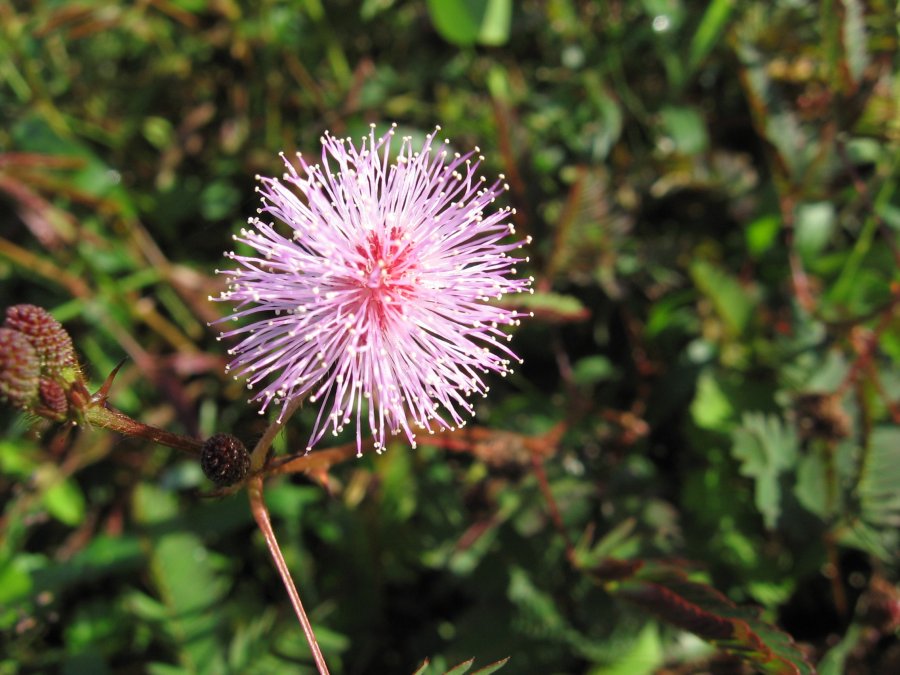
Friday, October 20, 2006
Harangi dam
I had been on a tour of Coorg last weekend. On my way back I visited the Harangi dam. It is a relatively big dam near Kushalanagar with hardly any villages nearby, so it is a nice, isolated place. Approach roads are quite good, so it is all nice and good till you reach there. Admission tickets are only Rs.2 per head. Then come the restrictions : Photography not permitted. Public are not allowed on the dam proper. Reason? Security. I was told that these measures started last year.
I find some of these restrictions pretty ridiculous. Especially the no photography one. We are living in an age where you can see an aerial photo of your home in Bangalore using Google Earth. Within a few years it may be possible to tell the brand of the ice cream sold at Harangi sitting at your desk in front of your computer. The other restriction about not lettting people on top of the dam was also quite meaningless. Especially considering the fact that they allow people at the base of the dam, right next to the wall of the dam. We could also go into the water on the other side of the dam, right upto the wall of the dam. You just don't get on the dam wall and you are fine :-)
When will the authorities realize the futility of such measures? The only purpose these measures are serving is to discourage tourists from visiting the place. That shows in the state of the garden around the dam, which appears to have been quite good once upon a time. The wisest thing to do would have been to develop the dam into a nice tourist place (garden, restaurant, water boats, the works) and provide basic security measures to ensure people don't walk in carrying any bombs/rocket launchers/artillery tanks! They could then bump up the entry fees to Rs.10 or 20 and people would be happy to pay that.
I find some of these restrictions pretty ridiculous. Especially the no photography one. We are living in an age where you can see an aerial photo of your home in Bangalore using Google Earth. Within a few years it may be possible to tell the brand of the ice cream sold at Harangi sitting at your desk in front of your computer. The other restriction about not lettting people on top of the dam was also quite meaningless. Especially considering the fact that they allow people at the base of the dam, right next to the wall of the dam. We could also go into the water on the other side of the dam, right upto the wall of the dam. You just don't get on the dam wall and you are fine :-)
When will the authorities realize the futility of such measures? The only purpose these measures are serving is to discourage tourists from visiting the place. That shows in the state of the garden around the dam, which appears to have been quite good once upon a time. The wisest thing to do would have been to develop the dam into a nice tourist place (garden, restaurant, water boats, the works) and provide basic security measures to ensure people don't walk in carrying any bombs/rocket launchers/artillery tanks! They could then bump up the entry fees to Rs.10 or 20 and people would be happy to pay that.
Wednesday, October 04, 2006
Nationalized bundhs
The 'bundh' called across Karnataka today is (kind of) supported by our own state Government. This is funny, because when the economists are calling for privatizing everything, Government wants move in opposite direction and take up conducting of strikes/bundhs in it's own hands! What next? Government-sponsored BMTC bus stoning?
Sunday, September 10, 2006
Digital generation gap
Well, it had to happen one day. There sure was going to be one day when there would be a cool new thing on the web and I was going to be too old-fashioned to pick it up. After all, how many new tricks can an old dog learn? What surprised me was that it happened so soon in my life. I am talking about the digital generation gap. The eerie feeling that creeps up your mind that you have started belonging to the previous generation and the next gen is ready to run you over.
I started using the Internet while the so called dot-com bubble was building up - mid to late nineties. So I was among the early users of many things on the Internet we take for granted now - web-based e-mail, web-based storage space, e-shopping, online chat, egroups (this was before Yahoo bought e-groups and named it Yahoo groups), etc. In the recent years I had transitioned well into a blogger's world, so I had blindly assumed that I had kept pace with the speed of the digital revolution (what exactly is that?)
I had heard about Orkut once in a while, mostly from people who are fresh out of college or who did so a couple of years back. I had conveniently assumed that it was one of the 'fringe' apps on the net I won't have to bother about. But eventually when I got an invite to join Orkut from Manju, it was time to really explore what it was all about. And what did I see? Everyone, their grandmoms and their dogs already seemed to be members of this online community! Many of my classmates from SJCE, many of my old friends living all around the globe were already on-board! There were communities that I really cared about and readily wanted to be a part of. It was as if I wokeup one morning and found that it had _snowed_ extensively in Bangalore and I did not even know about it. I was left wondering "Hey, how did I miss the bus?"
Now that I have caught up with it, I feel much better. However, I know that similar things are just waiting to happen again and one ofthese days I won't keep pace. So even though an actual human generation is around 25-30 years, a generation in the digital world will be much shorter. My guess is that people who are 10-15 years younger to us will belong to an entirely different generation altogether on the Internet. That is not a pleasant feeling, you know!
I started using the Internet while the so called dot-com bubble was building up - mid to late nineties. So I was among the early users of many things on the Internet we take for granted now - web-based e-mail, web-based storage space, e-shopping, online chat, egroups (this was before Yahoo bought e-groups and named it Yahoo groups), etc. In the recent years I had transitioned well into a blogger's world, so I had blindly assumed that I had kept pace with the speed of the digital revolution (what exactly is that?)
I had heard about Orkut once in a while, mostly from people who are fresh out of college or who did so a couple of years back. I had conveniently assumed that it was one of the 'fringe' apps on the net I won't have to bother about. But eventually when I got an invite to join Orkut from Manju, it was time to really explore what it was all about. And what did I see? Everyone, their grandmoms and their dogs already seemed to be members of this online community! Many of my classmates from SJCE, many of my old friends living all around the globe were already on-board! There were communities that I really cared about and readily wanted to be a part of. It was as if I wokeup one morning and found that it had _snowed_ extensively in Bangalore and I did not even know about it. I was left wondering "Hey, how did I miss the bus?"
Now that I have caught up with it, I feel much better. However, I know that similar things are just waiting to happen again and one ofthese days I won't keep pace. So even though an actual human generation is around 25-30 years, a generation in the digital world will be much shorter. My guess is that people who are 10-15 years younger to us will belong to an entirely different generation altogether on the Internet. That is not a pleasant feeling, you know!
Thursday, August 31, 2006
About FM radio station
With another FM radio station, Radio One opening up, the competition in the air is heating up. I keep switching radio stations while I drive (all males are genetically programmed to switch TV and radio channels at the rate of 1 channel about 5 seconds, sometimes just 2 seconds) and I have noticed that I am more often stopping at this new station to listen to a song or a conversation. So for now, Radio One is my favorite. But my loyalty can change very fast.
I wonder how people in Radio City feel about new stations coming up. They once had a share of 90+% of market, but I guess they don't have that much anymore. Radio broadcasting must be a very difficult field to innovate and stay on top of the heap.
I wonder how people in Radio City feel about new stations coming up. They once had a share of 90+% of market, but I guess they don't have that much anymore. Radio broadcasting must be a very difficult field to innovate and stay on top of the heap.
Sunday, August 20, 2006
Mad rush on Aug15
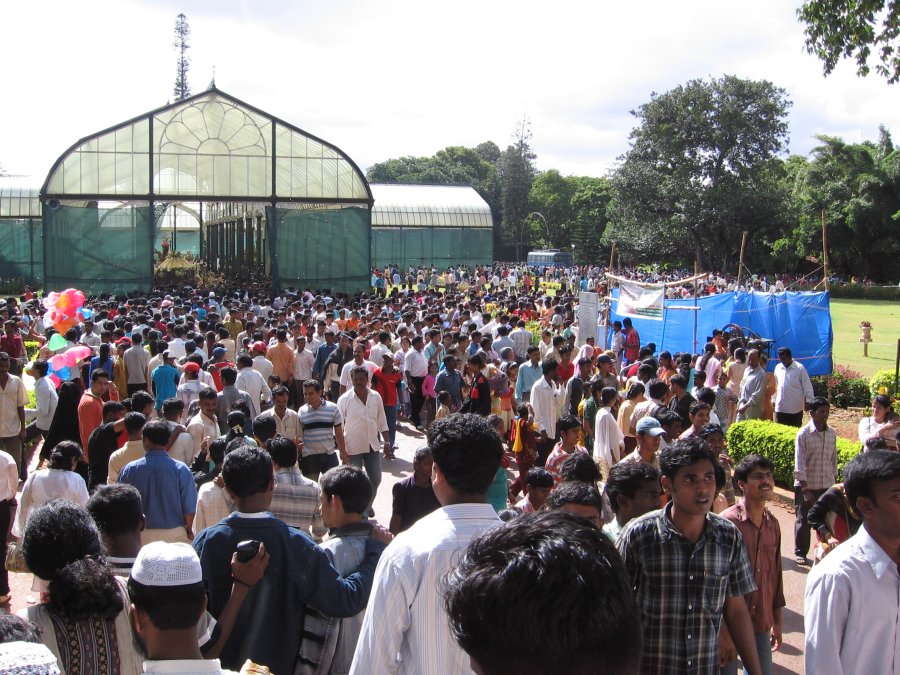 This year on August 15th, I committed one of the gravest mistakes that can be committed by a Bangalorean - Visiting Lalbagh flower exhibition on a weekly holiday, that too on the last day of the show. When I arrived at the gates of Lalbagh after several minutes of painful waiting in the traffic jam outside, the authorities there snatched Rs.50 from me and told me that I could park my car inside the bagh. They have a crooked sense of humour, I now think. Let alone park the car, I could consider myself lucky if I could just drive my car through the dense population inside! Once I (miraculously) found a place to park my car, I found that people pulling and pushing each other, cursing, grabbing each other by hair and so on to be able to make their way through the thousands of trying to do exactly the same! All this was not even inside, but on the way to the glass house. Situation inside the glass house was much more grim. Once we managed against all odds to get in, the only thing my wife wanted to do was get out of the glass house! Once we did that, the only thing she wanted to do was get out of Lalbagh!!!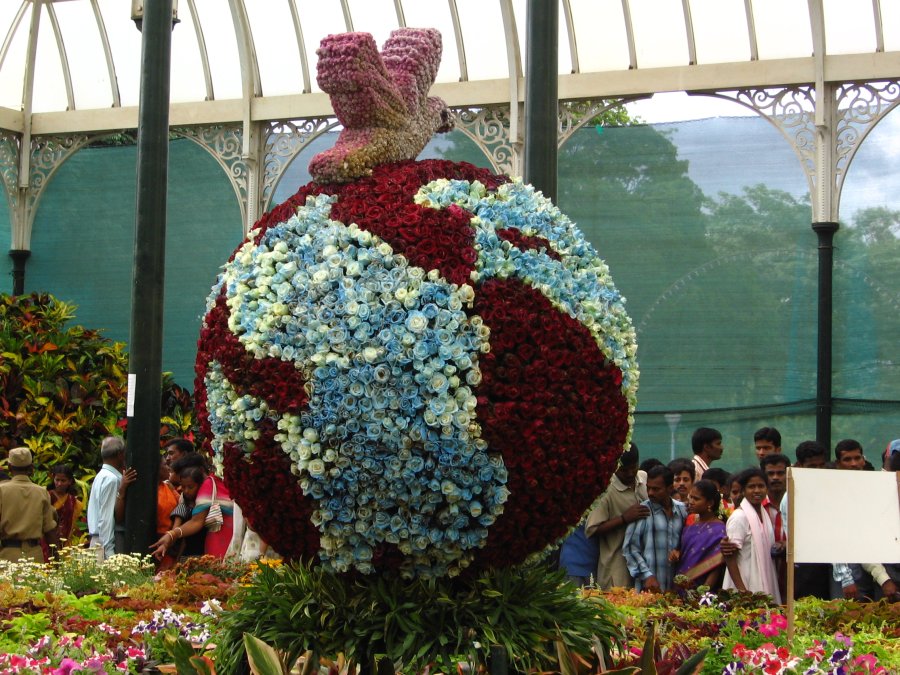
To give credit where it is due, flower show was probably very good. I don't know exactly, because all I saw were the heads and backs of other people who were trying like me to see the flowers. However, being a person who allows some time to smell the flowers, I did snatch a couple of pics on my camera before we left.
You would think that we learnt our lesson by this time and headed straight back home and spent the rest of the evening in frong of TV, but no sir, we don't learn so easily. We went straight to the new Big Bazaar just half kilometre away. They were running some sale that was ending on that day, hence large crowds eager to buy anything in the store were thronging the place. This place seemed to be an extension of Lalbagh as far as crowds are concerned, but with more spending opportunites. But it took us just a few minutes to learn our lessons this time. We decided not to venture to any such places on any such day ever again and headed back home.
The city is now filled with people who desperately want to have a good time and are ready to spend for it, but the infrastructure is not catching up.
Duh!
First, South Africa pulled out of the triangular cricket series in Srilanka and the series was reduced to 3 matches between India and Srilanka. Next, the rain gods decided to pour cold water on the excitement and the series got washed out. This is probably one of the most disappointing cricket series for cricket lovers. But was this the right time to hold a cricket series in the island nation? I don't know, but it looks like they decided to hold it bang in the middle of their rainy season. Wasn't it like holding a world ski competition in Chennai in the month of April or a golf tournament in, say, northern Canada in January? I guess we need to tell the Srilanka cricket authorities: "See guys, if this is your rainy season, it probably _will_ rain (surprise!) and it probably _will_ affect cricket matches adversely. What you need to plan is a swimming competition in your Colombo cricket stadium during this time of the year" How can we pay back the Lankans when they tour India next time? Plan some matches in Chirapunji? Or probably Jayanagar Swimming club? ;-)
Saturday, August 12, 2006
A new blog!
It has now been a bit more than an year since I started this blog. As an anniversary gift to 'devout' followers (I hope at least one person other than me is reading this blog), I am presenting, hold your breath and control your excitement, a second blog! The only thing better than having a crappy blog is having two of it ;-) I hope two bad things cancel it out. The second blog has been in my mind for a while now, but I was not sure how it was going to take shape. Now that I have decided to take it out of wraps, why don't you have a look at it and give your suggestions?
Please please please please please please please please please please please please please please please please have a look at it :-)) http://v-chitra.blogspot.com
Please please please please please please please please please please please please please please please please have a look at it :-)) http://v-chitra.blogspot.com
Saturday, August 05, 2006
Angry weather gods
Don't you feel the weather is turning out to be too extreme, too often in the last few years? In the last couple of years, I have heard about record-setting weather conditions all around the world. Last year, it was the deluge in Mumbai and Bangalore, the kind we had not ever seen. We also heard that the US had a record number of hurricanes last year, highlighted by Katrina. We then heard about the unusually heavy snowfall and cold in eastern parts of US and Canada. This year, there has been a never-heard summer in Europe and North America. I read that weather reporters in Europe have been forced to get new thermometers because their existing ones were not designed for temperatures this high. Many countries are recording all time high temperatures. The evergreen England too is drying up!
Is it just my imagination, or am I seeing far too many such incidences in the recent past? Record rainfalls, record heats, record deaths, especially in the more 'advanced' northern hemisphere of the Earth. Is it all a part of global warming? Or are these the early signs of the impending obscuration/cataclysm that Hindu mythology describes as "Pralaya"?
Is it just my imagination, or am I seeing far too many such incidences in the recent past? Record rainfalls, record heats, record deaths, especially in the more 'advanced' northern hemisphere of the Earth. Is it all a part of global warming? Or are these the early signs of the impending obscuration/cataclysm that Hindu mythology describes as "Pralaya"?
Friday, July 21, 2006
Ban on blogs lifted?
I can access my blog again! Looks like the Government has finally lifted the block they had put on blogspot (and other major blog sites?). So did the Government finally learn that the terrorists they are trying to catch are a too smart to depend only on blogspot for communication?
Year of Linux on the desktop?
Every year, I see articles on various Linux related websites that this year is going to be the year of Linux on the desktop, the year when Linux desktop will start gaining significantly on MS Windows. This claim is then supplemented by various comparisons between Windows and a recent Linux distro (often debian or gentoo), feature to feature, proving that Linux can now do all that Windows can. You get to hear that you can use Evolution in place of Outlook, Firefox in place of IE, f-spot in place Picasa, this is my favorite: gimp in place of Photoshop. That is not all, article usually claims that Linux now supports most of the digicams, display cards, etc out of the box, installation is extremely easy and everyone, his mom and grandmom can now use Linux on the desktop. Later, it mentions a couple of applications or a couple of features that are available on Linux, but not on Windows, to claim that Linux is already ahead of Windows. Examples are command-line image manipulation utilities, richness of bash shell as compared to Windows terminal.
However, every year, we realize that the share of Linux on the desktop is just the same as last year. The number of Linux-only desktop boxes will be so few, nobody wants to mention that.
Once upon a time, people said it was because of hardware support. Then they said availability of applications. However, Linux now supports almost all normal hardware and it has applications to serve any average computer user. (No, Photoshop is not a 'normal' software, hardly anybody needs it). So why is Linux not gaining on Windows on the desktop?
The main reason, as I can see it, is the ease of use. Windows is still infinitely more easy to use than Linux. Let me give an example. I consider myself a 'power user', not an 'average' user of Linux. The wireless card and bluetooth hardware is supported by the Linux distro I run. However, I have not been able to configure them correctly till today. I agree that I have not done a great deal of research, I have not spent a great number of hours googling for solutions. But all these got configured without asking me a single question on Windows. Most people don't care and don't want to know whether they should use WEP or WPA-PSK or whatever for their wireless card uses. Most people don't want to edit configuration options for everything they do. If Windows can self-discover all these things, why can't Linux?
The reason, to some extent, seems to be the 'Linux attitude'. Linux no doubt benefits from having some of the brightest people on the earth developing it. However, the same people cannot think for the common user. They tend to call the Windows way of doing things 'dumb', because it does not let them configure all the options by hand. They tend to despise any UI, advocating that command line is the only right way of doing things. This is true in some cases, but it definitely is wrong in case of most average 'dumb' users. For example, nobody outside the Linux fanatic club would want to understand the command line options of 'cdrecord'. The other reason is infinite choice you get with everything on Linux. There is no doubt choice is good, but all choice, no standardization is not good either.
The distros are doing a reasonable job of making desktop Linux a viable option. However, they too suffer from the same dificiency. Also, they spend more time polishing their fonts or creating new eye-catching 3-d icons than making apps easy to use. yum and apt are a good step towards installing software, but they bring Linux nowhere close to Windows in this area. To some extent, the Linux model, where there is no central authority, is the cause of this. Most of my thoughts agree with this article
So what do I think should be done? Portland project , which aims to provide common set of interfaces for Linux desktop, is a right way ahead. It may finally end the war between gnome and kde. I also think the community should become more sensitive to the needs of common man. I don't how how this can happen, though. I think the Linux distros should put more thought in making desktop versions of their OS. I installed SuSE Linux 10.1 last week and found that it is pretty well integrated desktop. (Until you try to install some software you found on the web). Some say the Linspire way is correct, but it is clear that they will never be able to garner support of the community for this, which means it will never take off in a big way. Last but not the least, until we have really made Linux on desktop comparable to Windows, let us not go around claiming that we are already better or that Windows is dumb.
However, every year, we realize that the share of Linux on the desktop is just the same as last year. The number of Linux-only desktop boxes will be so few, nobody wants to mention that.
Once upon a time, people said it was because of hardware support. Then they said availability of applications. However, Linux now supports almost all normal hardware and it has applications to serve any average computer user. (No, Photoshop is not a 'normal' software, hardly anybody needs it). So why is Linux not gaining on Windows on the desktop?
The main reason, as I can see it, is the ease of use. Windows is still infinitely more easy to use than Linux. Let me give an example. I consider myself a 'power user', not an 'average' user of Linux. The wireless card and bluetooth hardware is supported by the Linux distro I run. However, I have not been able to configure them correctly till today. I agree that I have not done a great deal of research, I have not spent a great number of hours googling for solutions. But all these got configured without asking me a single question on Windows. Most people don't care and don't want to know whether they should use WEP or WPA-PSK or whatever for their wireless card uses. Most people don't want to edit configuration options for everything they do. If Windows can self-discover all these things, why can't Linux?
The reason, to some extent, seems to be the 'Linux attitude'. Linux no doubt benefits from having some of the brightest people on the earth developing it. However, the same people cannot think for the common user. They tend to call the Windows way of doing things 'dumb', because it does not let them configure all the options by hand. They tend to despise any UI, advocating that command line is the only right way of doing things. This is true in some cases, but it definitely is wrong in case of most average 'dumb' users. For example, nobody outside the Linux fanatic club would want to understand the command line options of 'cdrecord'. The other reason is infinite choice you get with everything on Linux. There is no doubt choice is good, but all choice, no standardization is not good either.
The distros are doing a reasonable job of making desktop Linux a viable option. However, they too suffer from the same dificiency. Also, they spend more time polishing their fonts or creating new eye-catching 3-d icons than making apps easy to use. yum and apt are a good step towards installing software, but they bring Linux nowhere close to Windows in this area. To some extent, the Linux model, where there is no central authority, is the cause of this. Most of my thoughts agree with this article
So what do I think should be done? Portland project , which aims to provide common set of interfaces for Linux desktop, is a right way ahead. It may finally end the war between gnome and kde. I also think the community should become more sensitive to the needs of common man. I don't how how this can happen, though. I think the Linux distros should put more thought in making desktop versions of their OS. I installed SuSE Linux 10.1 last week and found that it is pretty well integrated desktop. (Until you try to install some software you found on the web). Some say the Linspire way is correct, but it is clear that they will never be able to garner support of the community for this, which means it will never take off in a big way. Last but not the least, until we have really made Linux on desktop comparable to Windows, let us not go around claiming that we are already better or that Windows is dumb.
Monday, July 10, 2006
State of affairs/ affairs of the State.
I am appalled by the level of politics being played out in Karnataka. I have not written much about politics in this blog so far. In fact I had planned to keep politics out of this completely. But I can't really hold myself, looking at what is happening.
Today I saw on TV our elected representatives physically fighting with each other in Vidhana Soudha because of personal rivalry. BMIC project was the first major controversy hit by Kumaraswamy, who started out as a very promising chief minister. The way BMIC is being handled is a HUGE discouragement to anyone planning to invest in Karnataka. Even if I were an invester, i would wisely choose other states. The new controversy about illegal mining too started out as a way to put Congress MLAs, who had mines in Kanakapura, in discomfort. However, the grandson of soil never thought it would snowball into such a big controversy. Our MLAs, spending crores of our money, are not even having meaningful discussions on the floor of the house. The concept that the elected body should concentrate on making legislations, leaving implementation to IAS officers has been completely forgotten. Corruption is not a hush-hush word to be kept away from media anymore. People of the state are too short sighted to realize where all this is headed. Like a saying goes, "people get a Government they deserve, not a Government they desire".
With nobody in any of the three major political parties to show a better way, I am saddened when I think what the future of this state will be like.
Today I saw on TV our elected representatives physically fighting with each other in Vidhana Soudha because of personal rivalry. BMIC project was the first major controversy hit by Kumaraswamy, who started out as a very promising chief minister. The way BMIC is being handled is a HUGE discouragement to anyone planning to invest in Karnataka. Even if I were an invester, i would wisely choose other states. The new controversy about illegal mining too started out as a way to put Congress MLAs, who had mines in Kanakapura, in discomfort. However, the grandson of soil never thought it would snowball into such a big controversy. Our MLAs, spending crores of our money, are not even having meaningful discussions on the floor of the house. The concept that the elected body should concentrate on making legislations, leaving implementation to IAS officers has been completely forgotten. Corruption is not a hush-hush word to be kept away from media anymore. People of the state are too short sighted to realize where all this is headed. Like a saying goes, "people get a Government they deserve, not a Government they desire".
With nobody in any of the three major political parties to show a better way, I am saddened when I think what the future of this state will be like.
End of sports season
Cricket got over a week back. With the FIFA world cup and the Wimbledon coming to an end this week, it suddenly feels like the sport season on television is over. Men can now return to informative(!) channels like AXN (programs like Fear Factor) and women can return to their entertaining(!) programs like saas-bahu soaps.
I lost most of the interest in football world cup during quarter final stages, when Argentina, Brazil and England went out. It was like a cricket world cup without Australia. My interest in Wimbledon was limited to Federer's finals and at some points in time during the finals, it looked like he too would lose, making it miserable. Luckily he held on. Federer reminds me of Sampras because of the way he keeps his composure in any situation of the match. I hope he wins many more grand slams.
I lost most of the interest in football world cup during quarter final stages, when Argentina, Brazil and England went out. It was like a cricket world cup without Australia. My interest in Wimbledon was limited to Federer's finals and at some points in time during the finals, it looked like he too would lose, making it miserable. Luckily he held on. Federer reminds me of Sampras because of the way he keeps his composure in any situation of the match. I hope he wins many more grand slams.
Thursday, June 29, 2006
A ripple in Karnataka newspaper industry
Consolidation among corporates seems to be in the air at the moment. The publication division of VRL group, which owns Vijaya Karnataka and Vijay Times, was taken over by Times of India group (Bennett, Coleman and Co. Ltd) recently. The story of Vijaya Karnataka is amazing. They entered the Kannada press industry at a stage when the industry was very mature and the existing players, like Prajavani, Udayavani, etc had long established their hold on the readers' mindshare. Nobody thought it would be possible to come up with a new newspaper at this stage and make it successful. It is like coming up with a new brand of soap today. It is easy to achieve phenomenal success in new areas by becoming pioneer in that area. Examples are AT&T, Vaseline, IBM, etc. However, entering a crowded market and winning customers over is not easy at all. But this is exactly what Vijaya Karnataka did. It is the largest circulated Kannada daily in Karnataka today.
With this aquisition, TOI group has immediately obtained reach to almost all parts of Karnataka through Vijaya Karnataka, unlike TOI which is popular only in Bangalore. Though this may turn out to be beneficial to Vijaya Karnataka, it is surely not good for me because I was subscribing to both TOI and Vijaya Karnataka. There is not meaning in reading two newspapers from the same publisher. I will have to change one. I guess I will move to Deccan Herald.
With this aquisition, TOI group has immediately obtained reach to almost all parts of Karnataka through Vijaya Karnataka, unlike TOI which is popular only in Bangalore. Though this may turn out to be beneficial to Vijaya Karnataka, it is surely not good for me because I was subscribing to both TOI and Vijaya Karnataka. There is not meaning in reading two newspapers from the same publisher. I will have to change one. I guess I will move to Deccan Herald.
Tuesday, June 20, 2006
Travelling on the Mysore highway
I drove down to Mysore last weekend on the old highway (probably the only highway we will have, with BMIC getting into controversy). With most of the work of making it a 4-lane road finished, it is a pleasure to drive on the road now. Compare this with the situation even a year back, when you would choose to rather be whipped than driving to Mysore in a small car. There are a few precautions to take on this road, though.
First, you will want to know which side of the road to drive on, the left or the right. The answer is "either". However, remember that if you are driving on the right side, you must have your head lights on :-)
Second, remember that the tractors have the highest right of way on the highway. It may be belonging to a farmer and a former Prime Minister may not take it lightly if you even honk at a farmer. Tractors need not turn on the head lights while travelling on the right side.
Third, how fast can you go? Answer is "depends". If you are within 10Kms distance of any village, be cautious about people crossing the road at their own sweet pace, cattle resting on the road, etc. All the time, keep a watch for vehicles coming directly at you (their right side), with their lights on. There is no exhilaration like travelling at 120kmph and suddenly realizing that there is a huge truck heading right at your car and you may be dead meat any moment. When you reach Ramanagar, be watchful for potholes. Small cars can get lost in some of them. Also, a handful of speedbreakers are intelligently placed in places where you least expect them, so watch out. I guess politicians promise for each village, apart from water, hospital, etc, two speedbreakers.
Should I overtake from left or the right side? Answer is "whichever lane is free". It is common to see trucks/autos travelling at 20kmph on the right lane and they don't intend to shift to left lane at all, so there is no meaning in sticking to rules.
Finally, where do I eat on the way? Answer is "Kamat Loka Ruchi". It is almost a unwritten rule that all cars must stop at Kamat to experience a urban, sophisticated feeling they are most used to in Bangalore - lack of parking space. After you manage against all odds to get a place to sit, you will be surprised to know that food is expensive, but not good! Masala dosa sucks big time. Coffee is not worth the Rs.12 they charge. I know this place used to be good, but I guess they have too many customers now to care about quality anymore. I hope it is so only on weekends.
First, you will want to know which side of the road to drive on, the left or the right. The answer is "either". However, remember that if you are driving on the right side, you must have your head lights on :-)
Second, remember that the tractors have the highest right of way on the highway. It may be belonging to a farmer and a former Prime Minister may not take it lightly if you even honk at a farmer. Tractors need not turn on the head lights while travelling on the right side.
Third, how fast can you go? Answer is "depends". If you are within 10Kms distance of any village, be cautious about people crossing the road at their own sweet pace, cattle resting on the road, etc. All the time, keep a watch for vehicles coming directly at you (their right side), with their lights on. There is no exhilaration like travelling at 120kmph and suddenly realizing that there is a huge truck heading right at your car and you may be dead meat any moment. When you reach Ramanagar, be watchful for potholes. Small cars can get lost in some of them. Also, a handful of speedbreakers are intelligently placed in places where you least expect them, so watch out. I guess politicians promise for each village, apart from water, hospital, etc, two speedbreakers.
Should I overtake from left or the right side? Answer is "whichever lane is free". It is common to see trucks/autos travelling at 20kmph on the right lane and they don't intend to shift to left lane at all, so there is no meaning in sticking to rules.
Finally, where do I eat on the way? Answer is "Kamat Loka Ruchi". It is almost a unwritten rule that all cars must stop at Kamat to experience a urban, sophisticated feeling they are most used to in Bangalore - lack of parking space. After you manage against all odds to get a place to sit, you will be surprised to know that food is expensive, but not good! Masala dosa sucks big time. Coffee is not worth the Rs.12 they charge. I know this place used to be good, but I guess they have too many customers now to care about quality anymore. I hope it is so only on weekends.
Monday, June 19, 2006
Google's software
Google seems to be in overdrive to release products. I am a sucker for Google products, so it is no surprise that I have been an 'early adapter' (AKA guinea pig) for a number of their products. I have been impressed with calendar, spreadsheet, page creator, firefox add-ons, Googleearth4.0 for Linux in the last couple of months. Gmail and Google have always been very useful. The only Google prodct that seemed to be a bad idea was the Firefox browser sync. Every time you start your browser, it first contacts Google's website and restores some information like bookmarks, saved sessions, etc. If you are on a slower connection, you need to wait for a good part of a minute for the browser to start. Browser sync also lets you store passwords, but that is a scary thing to do. I like the fact that they are coming out with Linux versions of their softwares. I tried Picasa for Linux. It runs through WINE, so it is not that good.
Sunday, June 11, 2006
Thursday, June 08, 2006
About Presiden't speech
I got an opportunity to listen live to our president, Dr Abdul Kalam recently. In the past I have wondered why he is such a popular person. But after listening to him, I know why.
Though he cannot be counted among the greatest orators, he seemed to be able to connect with his audience extremely well. His down-to-earth nature and genuine interest in the topics he was talking about, unlike politicians (I know he is not one), were the reasons for people instantly liking him. He had brought his own powerpoint slides for his talk (his choice of colors for slides was gaudy, if I may humbly add). It was clear that he had spent time specifically preparing for this presentation. He answered a few questions from the audience so nicely and promised to answer any question we may post on his website. If our politicians want to find a role model, they don't need to look too far.
Though he cannot be counted among the greatest orators, he seemed to be able to connect with his audience extremely well. His down-to-earth nature and genuine interest in the topics he was talking about, unlike politicians (I know he is not one), were the reasons for people instantly liking him. He had brought his own powerpoint slides for his talk (his choice of colors for slides was gaudy, if I may humbly add). It was clear that he had spent time specifically preparing for this presentation. He answered a few questions from the audience so nicely and promised to answer any question we may post on his website. If our politicians want to find a role model, they don't need to look too far.
Wednesday, May 24, 2006
Stock market crash
For the last few days I wanted to blog about the stock market crash. All newspapers carry front page articles showing investors in dispair whenever stock market crashes ("Investors lose <an abnoxiously high number> of crores of rupees") However, they don't raise so much noise when it goes up.
Today I found this article reflecting my thoughts on this issue. (first page, at least). So I guess linking to it, in true bloggers' spirit, is good enough.
Today I found this article reflecting my thoughts on this issue. (first page, at least). So I guess linking to it, in true bloggers' spirit, is good enough.
Monday, May 22, 2006
Eating in Bangalore
If you roam around the main shopping areas in Bangalore during the weekends, one thing clearly strikes you: Bangaloreans like to eat. Eat a lot. Be it a small road-side food joint like paani-puri stall or bonda-bajji shop or fruit juice place or a fancy and expensive restaurant, if it is in the right location, it is going to be crowded. If you go near Cool Joint in Jayanagar 4th block, you can see people putting their arms and legs at risk to grab their sandwich. The line at Ganesha Dosa camp in 3rd block is rumoured to reach at least a couple of kilometers. If you go to a nice restaurant on Saturday evening for dinner, you will be squarely asked to come back on the same time on Monday, because they are booked solid on Saturday and Sunday ;-) Bangaloreans quickly became rich, or at least spendy, but the infrastructure is not keeping up. If you want to have a nice, peaceful dinner during weekends, the only place to have it is your own home! If you are thinking of a second job, there is no better thing than to open a restaurant.
Wednesday, May 17, 2006
Saturday, April 29, 2006
Radio Mirchi
The day I realised that Radio Mirchi (I think this is their website, not sure though) had begun it's broadcast in Bangalore (93.3 MHz) was in fact one day before they came out with newspapers advertisements about their existence. But I heard that they had been on air for a while already. I was expecting them to come out with full page ads in all major newspapers the day they started out. This must be one of the softest of the 'soft launches' we have seen.
I like their tagline/slogan - "Sakkath hot maga". I also like the fact that their RJs can (and do) speak Kannada. I think they are after the FM Rainbow listeners first to build up a good listener base before taking on the Radiocity goliath. So far, I am listening. Go Mirchi!
On a related topic, we had just 3 FM stations in Bangalore till now. They differ greatly in the way they communicate with their listeners. Radiocity is the most informal ("Yo man", "hey gals", etc). FM Rainbow has the middle path ("Snehithare, Dinner Time karyakramadondige naanu nimma gelathi
I like their tagline/slogan - "Sakkath hot maga". I also like the fact that their RJs can (and do) speak Kannada. I think they are after the FM Rainbow listeners first to build up a good listener base before taking on the Radiocity goliath. So far, I am listening. Go Mirchi!
On a related topic, we had just 3 FM stations in Bangalore till now. They differ greatly in the way they communicate with their listeners. Radiocity is the most informal ("Yo man", "hey gals", etc). FM Rainbow has the middle path ("Snehithare, Dinner Time karyakramadondige naanu nimma gelathi
Thursday, April 27, 2006
A bit about my Delhi trip
I'm just logging a few things about my 1-day visit to Delhi this week. First of all, Bangalore airport. I have heard that the airport is asking airline companies not to introduce any more flights to Bangalore, because it cannot handle any more passengers. In this sense the airport truly represents Bangalore :-) When we got into the flight, there were enough mosquitoes to make an army of them. Just when all of us, especially the numerous westerners in the flight were wondering if we are going to survive the 2.5 hours journey among these mosquitoes, an air hostess brought and sprayed what smelt like a nice perfume. Only after a few minutes, when there were no more mosquitoes flying, did I realize that what she sprayed must have been baygon-spray-from-hell! Apparently, this spray also results in much nicer behavior of passengers towards the crew. Who would risk their life against such a spray ;-)
Delhi was nice. No, really. In my two very brief visits to Delhi, I have realized a few amazing things about the city. First, Delhi has glimpses of a revolutionary concept in vehicular movement, already popular in most other countries, called driving in lanes. Another phenomenon hardly heard of in Bangalore is that fly-over and metrorail construction actually coming to an end (I know that is hardest to believe). When Delhi'ites complain about traffic problems, it is mostly about traffic congestion. I am pretty sure they have not seen the type of jams we see in Bangalore, where all the city roads look like Kissan factory in peak hour. Except for weather, I wonder if anything is going for Bangalore anymore.
Delhi was nice. No, really. In my two very brief visits to Delhi, I have realized a few amazing things about the city. First, Delhi has glimpses of a revolutionary concept in vehicular movement, already popular in most other countries, called driving in lanes. Another phenomenon hardly heard of in Bangalore is that fly-over and metrorail construction actually coming to an end (I know that is hardest to believe). When Delhi'ites complain about traffic problems, it is mostly about traffic congestion. I am pretty sure they have not seen the type of jams we see in Bangalore, where all the city roads look like Kissan factory in peak hour. Except for weather, I wonder if anything is going for Bangalore anymore.
Saturday, April 15, 2006
Dr. Raj
By now newspapers have written enough, TV channels have shown more than enough, people have seen more than they wanted to see about the demise of Rajkumar and the violent funeral that followed. The mayhem that accompanied the procession and funeral were really ugly, unfortunate and unpardonable. Sure, this is not the first time we have seen processions marred with violence and lathi charges and this won't be the last. So I won't write too much about it.
In the history of Karnataka, I don't think any person has ever enjoyed such a great fan following. Sure, political leaders have managed to rope in a large gathering to listen to their speeches, devotees have gathered in large numbers to listen to their spiritual leader. However, nobody, neither the great political leaders, nor the spiritual Gurus, not even kings have ever managed to build such a great fan following across all economic and social levels of a society. This is the kind of reverence politicians dream about achieving all their lives. If my understanding is right, Rajkumar was the best example of people uniting around a man based just on Kannada and nothing else. Rajkumar is great for having achieved such an iconic stature. If you are a non-Kannadiga and not too knowledgeable about Karnataka, you must be wondering whether Kannadigas are going to go on a rampage like this every time one of their film stars dies. Rest assured, anything quite like this and this spontaneous won't happen ever again. Nobody else has such a pull on the society.
The events at Rajkumar's death was surely going to be unprecedented. But what really happened was far beyond the expectation of the state machinery. How can the police control the mobs, when some lunatics think "I was unable to see Annavru's body. Obviously, it is the fault of that big BMTC bus. Let me go and smash up it's windshield and light it up as a revenge"
In the history of Karnataka, I don't think any person has ever enjoyed such a great fan following. Sure, political leaders have managed to rope in a large gathering to listen to their speeches, devotees have gathered in large numbers to listen to their spiritual leader. However, nobody, neither the great political leaders, nor the spiritual Gurus, not even kings have ever managed to build such a great fan following across all economic and social levels of a society. This is the kind of reverence politicians dream about achieving all their lives. If my understanding is right, Rajkumar was the best example of people uniting around a man based just on Kannada and nothing else. Rajkumar is great for having achieved such an iconic stature. If you are a non-Kannadiga and not too knowledgeable about Karnataka, you must be wondering whether Kannadigas are going to go on a rampage like this every time one of their film stars dies. Rest assured, anything quite like this and this spontaneous won't happen ever again. Nobody else has such a pull on the society.
The events at Rajkumar's death was surely going to be unprecedented. But what really happened was far beyond the expectation of the state machinery. How can the police control the mobs, when some lunatics think "I was unable to see Annavru's body. Obviously, it is the fault of that big BMTC bus. Let me go and smash up it's windshield and light it up as a revenge"
Tuesday, April 11, 2006
The fun about the Time of India...
...is that when pretty much every newspaper makes the fire in Meerut (that killed more than 50 people) the first news on their front page, TOI thinks the news about Salman Khan going to jail is more important! It is quite often that TOI puts 'masala' items on the front page (like dress code being imposed in Mount Carmel College, kids influencing buying habits of parents, etc) that appear on other pages in other newspapers. I guess their motto is "Anything for marketshare"!
Friday, April 07, 2006
Mass exodus from Bangalore
No, this is not about the IT-BT industry relocating to Chennai and Hyderabad. (I am not worried about that anymore).
Most people living in Bangalore, including Kannadigas, are not natural Bangaloreans. So whenever there is a long weekend, a very large number of people take off from the city to visit their hometowns. This happened again last week, when people took off for a 4-day weekend for Ugadi. I was one of them, trying to get onto a bus on 29th night. When my auto eventually approached the bus stand (Majestic), I noticed that traffic had piled up for at least 2 kilometres from the bus stand. I have no idea how any of the vehicles on K.G Road reached the bus stand that day. My auto driver passed through all the narrowest roads around the main road, some of the roads so narrow people fear to attempt them on two-wheelers, and eventually reached the bus stand. Once in, I noticed that KSRTC had introduced a large number of extra buses for this day, so they had piled up all inside the bus stand and all roads surrounding it. They were running a bus EVERY SINGLE MINUTE from 11PM till 11:30PM to Shimoga alone! Of course, once our bus made it's way out of the bus stand (one hour late), it got stuck in a huge traffic pile up on Tumkur road created by numerous vehicles going out of the city. It really looked like people were fleeing a disaster-hit city.
This problem will only get worse as days go by. I plan to take an extra day off in such cases and go out of the city one daysooner from now on.
Most people living in Bangalore, including Kannadigas, are not natural Bangaloreans. So whenever there is a long weekend, a very large number of people take off from the city to visit their hometowns. This happened again last week, when people took off for a 4-day weekend for Ugadi. I was one of them, trying to get onto a bus on 29th night. When my auto eventually approached the bus stand (Majestic), I noticed that traffic had piled up for at least 2 kilometres from the bus stand. I have no idea how any of the vehicles on K.G Road reached the bus stand that day. My auto driver passed through all the narrowest roads around the main road, some of the roads so narrow people fear to attempt them on two-wheelers, and eventually reached the bus stand. Once in, I noticed that KSRTC had introduced a large number of extra buses for this day, so they had piled up all inside the bus stand and all roads surrounding it. They were running a bus EVERY SINGLE MINUTE from 11PM till 11:30PM to Shimoga alone! Of course, once our bus made it's way out of the bus stand (one hour late), it got stuck in a huge traffic pile up on Tumkur road created by numerous vehicles going out of the city. It really looked like people were fleeing a disaster-hit city.
This problem will only get worse as days go by. I plan to take an extra day off in such cases and go out of the city one daysooner from now on.
Monday, April 03, 2006
Winged visitor at my home
 I have always felt sorry for the sparrows, which have lost their habitat ever since our cities and towns got filled with RCC buildings. After we shifted to our new house, since there is a lot of free space all around, it is common to see many varieties of birds around our house. Today, when I returned home, I was told that a sparrow had entered the house! I found him sitting very quietly, as if it was just a stuffed model, on a CFL bulb. I am guessing it is a 'he' (and not 'she'), because he is perched on electrical equipement, which is a 'manly' object ;-) I heard that he tried to get out of the house, but could not find his way out. Since he did not ask for directions, there is no doubt it is a 'he'! He is still there, hopefully we will be able to send him off tomorrow morning. I am too scared to even switch on a ceiling fan today, what if he flies right to it? Meanwhile a lizard on the wall has checked him out from a distance. Luckily the lizard did not go too near or tease the bird too much, so they are both at peace now. Good night, dear bird!
Update (4Apr) The bird promptly flew out of my house this morning the moment we opened all doors and windows. Goodbye!
Thursday, March 23, 2006
Your favorite cartoon characters now speak Kannada!
Here is a blog that has famous cartoon strips translated to Kannada. Very unique and nice. Instead of doing a literal translation which screws up the humour completely (like most commercials on TV), this blog tries to be creative with the translated text. Names are also 'Kannada-fied'. Garfield becomes Govinda, Calvin is Keshava/Keshu and Wally, the famous co-worker of Dilbert becomes (I am not making this up!) Venkatachala!!
I am not sure how 'legal' these cartoons are, I am pretty sure they are violating some copyrights. Enjoy it while it lasts!
I am not sure how 'legal' these cartoons are, I am pretty sure they are violating some copyrights. Enjoy it while it lasts!
Wednesday, March 08, 2006
All those who want to fly Air Deccan,
Please demand to see the plane with your own eyes before booking your ticket. Looks like sometimes Air Deccan can be just air. I think the best flying experience in India now-a-days is on Kingfisher airlines. I admire Vijay Mallya - because here is a guy who has money, is willing to spend it and knows how.
Saturday, March 04, 2006
First rain of the year
It rained in Bangalore yesterday. Rains in the first week of March are a rarity anywhere in India, but Bangalore has been receiving rains during non-rainy-season regularly in the last few years. Pretty much every year, Bangalore has been receiving considerable amount of rain in March, April and May months. In fact of late Bangalore continues to receive rains all the way till November! So there is no need to be surprised. These occasional rains keep our city cooler and of course, humid.
Old timers in Bangalore are often heard saying "It used to be so cold in Bangalore during that time. Now the city has gets too hot in summer. But contrary to what they say, weather records show that the average summer temperature in Bangalore has only gone up by half degree in the last 50 years. Of course, We have fewer trees inside the city now, so we feel the heat more now.
Rains bring some miseries to me since I moved to my new house in Bilekahalli. First of all, the very first sign of an impending rain results in our area losing electricity. It is as if the rain drops, if allowed to touch electric wires, will cause an explosion or something. Secondly, due to all the construction activity and total lack of asphault on roads, roads quickly turn messy. Third, with empty lands all around, water accumulates in them and does not flow out easily. Hence I hope the rains start late this year. But I am not very hopeful!
Old timers in Bangalore are often heard saying "It used to be so cold in Bangalore during that time. Now the city has gets too hot in summer. But contrary to what they say, weather records show that the average summer temperature in Bangalore has only gone up by half degree in the last 50 years. Of course, We have fewer trees inside the city now, so we feel the heat more now.
Rains bring some miseries to me since I moved to my new house in Bilekahalli. First of all, the very first sign of an impending rain results in our area losing electricity. It is as if the rain drops, if allowed to touch electric wires, will cause an explosion or something. Secondly, due to all the construction activity and total lack of asphault on roads, roads quickly turn messy. Third, with empty lands all around, water accumulates in them and does not flow out easily. Hence I hope the rains start late this year. But I am not very hopeful!
Subscribe to:
Posts (Atom)